

Get Prepared for Your OGBA-101 Exam With Actual The Open Group Study Guide!
Pass Your Next OGBA-101 Certification Exam Easily & Hassle Free
The Open Group OGBA-101 Exam Syllabus Topics:
| Topic | Details |
|---|---|
| Topic 1 |
|
| Topic 2 |
|
| Topic 3 |
|
| Topic 4 |
|
| Topic 5 |
|
| Topic 6 |
|
| Topic 7 |
|
NEW QUESTION # 35
Question: Which ADM Phases match the following purpose descriptions?
- A. 1 Phase C - 2 Phase E - 1 Phase H - 4 Phase C
- B. 1 Phase D - 2 Phase B - 3 Phase G - 4 Phase A
- C. 1 Phase C - 2 Phase F - 3 Phase G- 4 Phase D
- D. 1 Phase C - 2 Phase F - 3 Phase H - 4 Phase B
Answer: C
Explanation:
The ADM Phases that match the purpose descriptions provided are: Phase C for the development of Information Systems Architectures to support the agreed Architecture Vision, Phase F for addressing the move from the Baseline to the Target Architectures by finalizing a detailed Implementation and Migration Plan, Phase G for providing architectural oversight of the implementation, and Phase D for describing the development of the Technology Architecture to support the agreed Architecture Vision.
NEW QUESTION # 36
Which artifact identifies business information concepts without considering implementation?
- A. Information Map
- B. Data Model
- C. Application Portfolio
- D. Technology Catalog
Answer: A
Explanation:
An Information Map defines key business information concepts and their relationships. It remains independent of databases, applications, or physical storage, ensuring information architecture reflects business requirements instead of technical implementation decisions.
NEW QUESTION # 37
In what TOGAF ADM phase is the organization map linked built out with the detail and relationships to overviews in order to understand the needs of the organization?
- A. Phase B
- B. Phase E
- C. Phase A
- D. Preliminary Phase
Answer: C
Explanation:
Phase A (Architecture Vision) of the TOGAF ADM builds out initial organizational maps to understand high-level organizational needs and link them to architecture goals. This step provides foundational insight that informs subsequent phases, particularly for stakeholder alignment.
NEW QUESTION # 38
Complete the sentence. The TOGAF standard covers the development of four architecture domains. Business.
Data. Technology and___________.
- A. Segment
- B. Capability
- C. Application
- D. Transition
Answer: C
Explanation:
The TOGAF standard covers the development of four architecture domains: Business, Data, Technology, and Application. The Application Architecture domain defines the applications required to process the data and support the business functions.
The TOGAF standard describes the development of four architecture domains, which are considered its pillars.
These are Business, Data, Technology, and Application. The Application Architecture domain provides a blueprint for the individual application systems to be deployed, their interactions, and their relationships to the core business processes of the organization.
NEW QUESTION # 39
Consider the following Business Capability Example:
Which of the following are A and C?
- A. Organization. Data.
- B. Roles, Information.
- C. Actors, Actions.
- D. Who. What.
Answer: B
Explanation:
According to the TOGAF Business Capabilities Guide V2, a business capability is defined as "the expression or the articulation of the capacity, materials, and expertise an organization needs in order to perform core functions"5. A business capability can be decomposed into four elements: roles, information, processes, and technology5. In the given example, A represents roles and C represents information.
NEW QUESTION # 40
Which Business Architecture technique is most useful for understanding interactions between stakeholders and business objectives?
- A. Technology Portfolio
- B. Platform Matrix
- C. Infrastructure Diagram
- D. Stakeholder Map
Answer: D
Explanation:
A Stakeholder Map identifies stakeholders, their concerns, influence, and relationships to business objectives. It helps architects develop communication strategies and ensure stakeholder expectations are considered throughout the architecture development process.
NEW QUESTION # 41
Which of the following is a derived relationship in an organization map?
- A. Scope of enterprise
- B. Capability
- C. Location
- D. Value flow
Answer: D
Explanation:
According to the TOGAF Series Guide: Organization Mapping, one of the derived relationships in an organization map is value flow1. A value flow is a relationship that shows how value is exchanged between business units or other entities in an organization map1. A value flow can be expressed as a verb phrase that indicates what type of value is transferred or shared between entities1. For example, in an organization map for an online retailer, a possible value flow could be "Delivers products" between the Warehouse business unit and the Customer entity.
https://pubs.opengroup.org/togaf-standard/business-architecture/organization-mapping.html
NEW QUESTION # 42
Which of the following is a purpose of mapping capabilities to value stream stages?
- A. To provide a self-contained business description that is independent of the organizational structure.
- B. To identify and eliminate business capabilities that do not contribute to the business.
- C. To describe the business in terms of services provided and consumed.
- D. To classify, group, and align capabilities into categories for a deeper understanding.
Answer: D
Explanation:
Mapping capabilities to value stream stages in TOGAF is crucial for understanding how different capabilities contribute to the overall value delivery process. Here's a detailed explanation:
* Value Streams and Business Capabilities:
* Value Streams: Represent end-to-end collections of activities that create value for stakeholders.
* Business Capabilities: Define what an organization needs to be able to do to achieve its business objectives.
* Purpose of Mapping Capabilities to Value Stream Stages:
* Classification and Grouping: Mapping capabilities to value stream stages helps in classifying and grouping capabilities. This enables a structured understanding of how capabilities support different parts of the value delivery process.
* Alignment: Aligning capabilities with value stream stages ensures that each stage is supported by the necessary capabilities. This alignment helps in identifying gaps, redundancies, and areas for improvement.
* Deeper Understanding: By mapping capabilities to value stream stages, architects gain a deeper understanding of how capabilities interact and contribute to the overall business strategy and value creation process.
* TOGAF References:
* Phase B: Business Architecture: This phase involves defining the baseline and target business architectures, where mapping capabilities to value streams is a key activity. It ensures that the architecture supports the strategic goals and value streams of the organization.
* Capability-Based Planning: TOGAF emphasizes capability-based planning, where business capabilities are mapped to value streams to ensure alignment and effective support for business processes.
* Benefits:
* Improved Planning: This mapping facilitates better planning and decision-making by providing a clear picture of how capabilities support value streams.
* Resource Allocation: Helps in efficient allocation of resources by identifying which capabilities
* are critical for each stage of the value stream.
In summary, mapping capabilities to value stream stages classifies, groups, and aligns capabilities into categories for a deeper understanding, ensuring that the architecture supports the overall value delivery process effectively.
NEW QUESTION # 43
Which of the following best describes why business model innovation should be approached in a structured manner?
- A. To provide a consistent and measurable level of quality information to decision-makers.
- B. To adapt to changes in the organization structure to meet a new market need.
- C. To ensure that changes to business models can interact with the existing architecture.
- D. To enable the business to thrive in a state of constant motion.
Answer: C
Explanation:
Business model innovation involves making significant changes to how an organization creates, delivers, and captures value. These changes can be disruptive and have far-reaching implications for the entire enterprise. A structured approach to business model innovation is essential to:
Maintain alignment with enterprise architecture: A structured approach ensures that new business models are compatible with the existing technology, data, and application architecture. This prevents costly rework, integration issues, and disruptions to existing operations. Minimize risk and disruption: By carefully considering the impact of changes on different parts of the organization, a structured approach helps to mitigate risks and avoid unintended consequences.
Facilitate effective decision-making: A structured approach provides a framework for evaluating different business model options and making informed decisions based on clear criteria and analysis. Enable smooth transition: A structured approach helps to manage the transition to the new business model, ensuring a smooth implementation and minimizing disruptions to customers and employees.
NEW QUESTION # 44
A Business Model explains how an organization creates, delivers, and captures:
- A. Value
- B. Technology
- C. Governance
- D. Information
Answer: A
Explanation:
A Business Model describes how an organization creates value for customers, delivers that value efficiently, and captures benefits such as revenue or strategic advantage. It explains the organization's overall approach to value creation.
NEW QUESTION # 45
Consider the following modeling example, relating business capabilities to organization units so as to highlight duplication and redundancy:
(Note in this example the cells colored green, yellow, and red, are also marked G. Y, and R, respectively) Which of the following best describes this technique?
- A. Capability Mapping
- B. Perspective Analysis
- C. Relationship Mapping
- D. Gap Analysis
Answer: C
Explanation:
The technique shown in the example is called relationship mapping. It is a technique that can be used to show how a business architecture addresses stakeholder concerns across different parts of an organization. It can highlight gaps or overlaps in the coverage of stakeholder concerns by a business architecture. In this case, the technique is used to relate business capabilities to organization units so as to highlight duplication and redundancy.
This modeling technique is referred to as Relationship Mapping. It's used to relate business capabilities to organizational units to highlight areas of duplication and redundancy, as well as to indicate where capabilities are being performed well (green), where there are potential issues (yellow), and where there are significant problems or gaps (red). This visualization helps in understanding the alignment between organizational units and capabilities, and where improvements or changes may be needed.
NEW QUESTION # 46
Which of the following best describes "value" in the context of Business Architecture?
- A. The benefit of something.
- B. The monetary worth of something.
- C. The market price of something.
- D. A numerical quantity assigned to something.
Answer: A
Explanation:
In Business Architecture, "value" refers to the benefit provided to stakeholders, aligning with TOGAF's goal to capture and deliver value in business processes and capabilities. Business value is viewed as outcomes or improvements that meet stakeholder needs, rather than purely financial or numerical metrics.
NEW QUESTION # 47
Which of the following is a benefit of organization mapping?
- A. An organization map highlights inefficiencies and reduces operational costs.
- B. An organization map improves strategic planning.
- C. An organization map improves the ability to consume, process, and deliver information.
- D. An organization map can be reused for training and employee development.
Answer: B
Explanation:
One of the benefits of organization mapping is that it improves strategic planning2. Organization mapping is a technique that can be used to document and visualize the organizational structure and relationships of an enterprise or a part of it2. Organization mapping can help to align the organizational design with the business strategy, goals, and objectives2. Organization mapping can also help to identify the roles, responsibilities, authorities, accountabilities, and dependencies of different organizational entities2. By providing a clear and consistent view of the organizational landscape, organization mapping can enable better informed and more effective decisions for strategic planning.
NEW QUESTION # 48
Complete the sentence. The purpose of the Preliminary Phase is to:
- A. Describe the target architecture.
- B. Architect an Enterprise Architecture Capability.
- C. Identify the stakeholders and their requirements.
- D. Define the enterprise strategy.
Answer: B
Explanation:
In the TOGAF ADM, the Preliminary Phase sets up the architecture capability within the organization, establishing architecture governance, defining architecture principles, and setting up necessary processes and tools. This phase is crucial for laying the foundation before formal architecture development begins.
NEW QUESTION # 49
Why is an Information Map valuable during Business Architecture development?
- A. It specifies application interfaces.
- B. It documents network configurations.
- C. It defines physical database structures.
- D. It identifies business information required to support capabilities.
Answer: D
Explanation:
An Information Map identifies the business information needed by capabilities and value streams.
It provides a shared business view of information without depending on specific databases, applications, or technology implementations.
NEW QUESTION # 50
Complete the following sentence:
Presenting different ____ and ____ to stakeholders helps architects to extract hidden agendas, principles, and requirements that could impact the final Target Architecture.
- A. Business Scenarios, Business Models
- B. Alternatives, Trade-offs
- C. Architecture Views, Architecture Viewpoints
- D. Solutions, Applications
Answer: C
Explanation:
Presenting differentalternatives and trade-offsto stakeholders is a crucial technique in TOGAF for eliciting valuable feedback and refining the Target Architecture. This approach encourages stakeholders to actively participate in the architecture development process and express their preferences and concerns.
Here's why this approach is effective:
* Reveals hidden agendas:By presenting different options with varying implications, stakeholders may reveal priorities or concerns that were not explicitly stated before. This helps architects uncover hidden agendas that could influence the architecture's success.
* Uncovers underlying principles:Stakeholder reactions to different alternatives can reveal their underlying principles and values, providing insights into what they consider important in the architecture.
* Identifies unspoken requirements:Through discussions and comparisons of alternatives, stakeholders may express needs or requirements that were not captured during initial requirements gathering.
NEW QUESTION # 51
Business Capabilities should generally be:
- A. Project-specific
- B. Stable over time
- C. Organizationally dependent
- D. Technology-specific
Answer: B
Explanation:
Capabilities represent enduring business abilities rather than temporary organizational structures or technologies. Their stability allows architects to compare business performance, prioritize investments, and support strategic transformation across multiple organizational changes.
NEW QUESTION # 52
Complete the sentence. A key principle of value streams is that value is always defined from the perspective of the_____________
- A. Architect
- B. Stakeholder
- C. Sponsor
- D. Shareholder
Answer: B
Explanation:
A key principle of value streams is that value is always defined from the perspective of the stakeholder2. A stakeholder is any person or group who has an interest in or influence on an enterprise or its activities5. A stakeholder can be internal or external to the enterprise. A stakeholder can also be a customer, end user, partner, supplier, regulator, employee, or any other role that interacts with or benefits from the enterprise's products or services5. Value streams should reflect how stakeholders perceive and measure value in terms of outcomes, benefits, costs, risks, and satisfaction2.
NEW QUESTION # 53
Consider the following ADM phases objectives.
Which phase does each objective match?
- A. 1G-2E-3F-4E
- B. 1E-2F-3E-4G
- C. 1F-2F-3E-4G
- D. 1F-2G-3F-4F
Answer: D
NEW QUESTION # 54
In the diagram, what are the items labelled A, B, and C?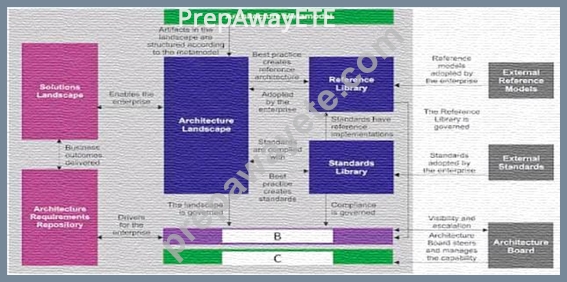
- A. A-Enterprise Repository, B-Governance Repository. C-Board Repository
- B. A-Architecture Repository, B-Governance Repository. C-Architecture Capability
- C. Enterprise Repository, B-Board repository, C-Enterprise Capability
- D. A-Architecture Repository, B-Governing Board, C-Enterprise Capability
Answer: D
Explanation:
In the provided diagram, item A refers to the Architecture Repository, which is a part of the TOGAF framework where all the architecture assets are stored. This includes the architectural models, patterns, architecture descriptions, and other artifacts relevant to the architecture. Item B is labeled as the Governing Board, which is likely referring to the Architecture Board or a similar governance structure responsible for oversight and decision-making regarding the enterprise architecture. Item C refers to Enterprise Capability, which encompasses the processes, tools, skills, and other capabilities that enable the architecture function within the enterprise.
NEW QUESTION # 55
Consider the following chart:
Which important concept for Enterprise Architecture Practitioners does it illustrate?
- A. Enterprise Architects must use Gantt charts to communicate with Stakeholders.
- B. ADM phases must be run in a sequenced approach to produce the Architecture
- C. An Enterprise Architecture must be developed in phases with a limited fixed duration.
- D. ADM phases must be run simultaneously until the relevant information has been produced
Answer: B
Explanation:
The chart depicted is a Gantt chart, which typically represents the schedule for project activities. In the context of TOGAF's ADM, it is used to illustrate the sequence and interdependencies of tasks across different phases of architecture development. The ADM is an iterative cycle that includes various phases, from the preliminary phase, through architecture vision, business, information systems, and technology architectures, to opportunities and solutions, migration planning, implementation governance, and architecture change management. Each phase must be conducted in a sequence to ensure that the outputs of one phase feed into the next, thereby producing a coherent and structured architecture.
NEW QUESTION # 56
When developing a Business Architecture, which of the following is recommended if an enterprise has existing Architecture Descriptions?
- A. They should be reviewed, and work packages identified for portfolio planning.
- B. They should be added to the Governance Repository within the Architecture Repository.
- C. They should be used as the basis for the Baseline Description.
- D. They should be used to validate the business principles.
Answer: C
Explanation:
When developing a Business Architecture, TOGAF provides guidance on how to leverage existing architecture descriptions to build a comprehensive and accurate Baseline Description. Here's a step-by-step explanation:
Existing Architecture Descriptions:
Existing architecture descriptions provide valuable insights into the current state of the enterprise's architecture. These descriptions can include documentation of processes, systems, technologies, and organizational structures.
Baseline Description:
The Baseline Description represents the current state of the enterprise architecture. It serves as the starting point for developing the Target Architecture and planning the transition from the current state to the future state.
Using Existing Descriptions:
Review and Analyze: Existing architecture descriptions should be reviewed and analyzed to understand the current state accurately. This involves identifying all relevant artifacts, documents, and data.
Integration into Baseline: The information from the existing descriptions should be integrated into the Baseline Description. This ensures that the Baseline accurately reflects the current state, providing a solid foundation for future planning.
Gaps and Opportunities: By using existing descriptions, architects can identify gaps in the current architecture and opportunities for improvement. This helps in formulating a more effective Target Architecture.
TOGAF ADM Reference:
Phase A: Architecture Vision: This phase involves establishing the architecture vision, which includes defining the scope and approach for the Baseline Description.
Phase B: Business Architecture: During this phase, the Baseline Business Architecture is developed using existing architecture descriptions as a key input.
In summary, using existing architecture descriptions as the basis for the Baseline Description ensures that the current state is accurately documented, providing a reliable foundation for developing the Target Architecture and planning the transition.
NEW QUESTION # 57
Which of the following best describes a benefit of business models?
- A. They can be used to calculate detailed cost estimates.
- B. They can be used to resolve conflicts amongst different stakeholders.
- C. They provide a different viewpoint to cross-check assumptions.
- D. They highlight what the business does without the need to explain why.
Answer: C
Explanation:
Business models are essential tools within TOGAF for providing different perspectives on the business operations, strategies, and value propositions. Here's a detailed explanation:
* Purpose of Business Models:
* Business models are designed to represent various aspects of the business, such as value creation, delivery, and capture mechanisms. They provide a structured way to analyze and understand the business.
* Different Viewpoint:
* Cross-Check Assumptions: Business models offer a different viewpoint that helps in validating and cross-checking assumptions made about the business. By presenting a visual and structured representation of the business, these models enable stakeholders to identify gaps, inconsistencies, and areas that need further analysis.
* Holistic Understanding: They help in gaining a holistic understanding of how different components of the business interact, which is crucial for ensuring that the enterprise architecture aligns with the business strategy and goals.
* TOGAF References:
* Phase A: Architecture Vision: During this phase, business models are used to articulate the vision and scope of the architecture effort. They help in ensuring that all assumptions are validated and that the architecture aligns with business objectives.
* Phase B: Business Architecture: Business models are also utilized in this phase to analyze business capabilities, processes, and value streams. They provide a different viewpoint that aids in identifying areas for improvement and ensuring alignment with the strategic intent.
In summary, business models provide a different viewpoint that helps cross-check assumptions, ensuring that the enterprise architecture is aligned with the business strategy and objectives.
NEW QUESTION # 58
Which statement best describes iteration and the ADM?
- A. The ADM is iterative between phases B to D, and between Phases E and F.
- B. The ADM is iterative, over the whole process, between phases, and within phases.
- C. The level of detail is defined once and applies to all iterations.
- D. The ADM is sequential. Iteration is applied within phases.
Answer: B
Explanation:
TOGAF's ADM (Architecture Development Method) is designed to be iterative at multiple levels: over the whole process, between phases, and within phases. This iterative approach allows for continuous refinement and improvement of the architecture, ensuring it remains aligned with changing business needs and technological advancements. Iteration helps in managing complexity and facilitates incremental development, enabling architects to revisit and adjust their work as new information and insights emerge.
NEW QUESTION # 59
When developing a Business Architecture, which of the following is recommended if an enterprise has existing Architecture Descriptions?
- A. They should be reviewed, and work packages identified for portfolio planning.
- B. They should be added to the Governance Repository within the Architecture Repository.
- C. They should be used as the basis for the Baseline Description.
- D. They should be used to validate the business principles.
Answer: C
Explanation:
When developing a Business Architecture, TOGAF provides guidance on how to leverage existing architecture descriptions to build a comprehensive and accurate Baseline Description.
Existing Architecture Descriptions:
Existing architecture descriptions provide valuable insights into the current state of the enterprise's architecture. These descriptions can include documentation of processes, systems, technologies, and organizational structures.
Baseline Description:
The Baseline Description represents the current state of the enterprise architecture. It serves as the starting point for developing the Target Architecture and planning the transition from the current state to the future state.
Using Existing Descriptions:
Review and Analyze: Existing architecture descriptions should be reviewed and analyzed to understand the current state accurately. This involves identifying all relevant artifacts, documents, and data.
Integration into Baseline: The information from the existing descriptions should be integrated into the Baseline Description. This ensures that the Baseline accurately reflects the current state, providing a solid foundation for future planning.
Gaps and Opportunities: By using existing descriptions, architects can identify gaps in the current architecture and opportunities for improvement. This helps in formulating a more effective Target Architecture.
NEW QUESTION # 60
......
Ace OGBA-101 Certification with 153 Actual Questions: https://www.prepawayete.com/TheOpenGroup/OGBA-101-practice-exam-dumps.html
Free The Open Group OGBA-101 Exam Question Practice Exams: https://drive.google.com/open?id=1azx_JutfC6ZR7PcoddF4sTfmg7t140p7