

[Oct-2025] Free JN0-664 Exam Dumps to Improve Exam Score
2025 Realistic JN0-664 Dumps Exam Tips Test Pdf Exam Material
NEW QUESTION # 27
The network shown in the exhibit is based on IS-IS.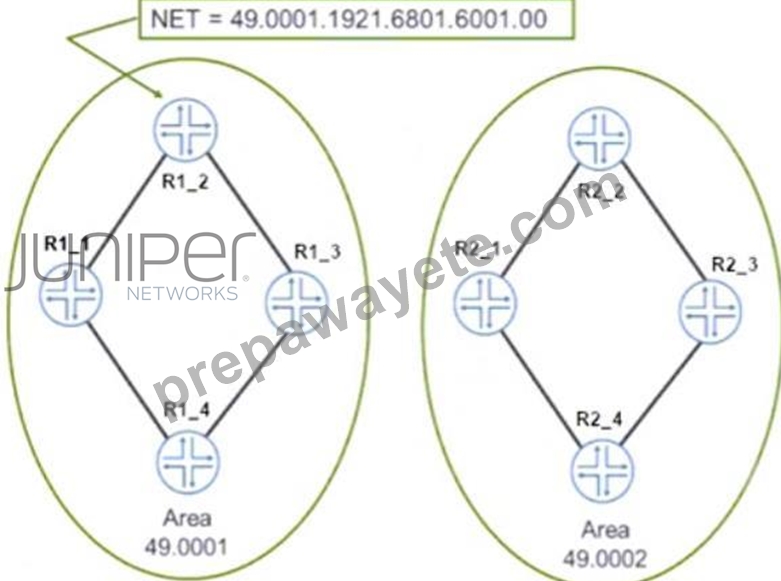
Which statement is correct in this scenario?
- A. The routers are using unnumbered interfaces.
- B. The NSEL byte for Area 0001 is 00.
- C. The system ID of R1_2 is 192.168.16.1.
- D. The area address is two bytes.
Answer: B
NEW QUESTION # 28
Which two statements about the output shown in the exhibit are correct? (Choose two.)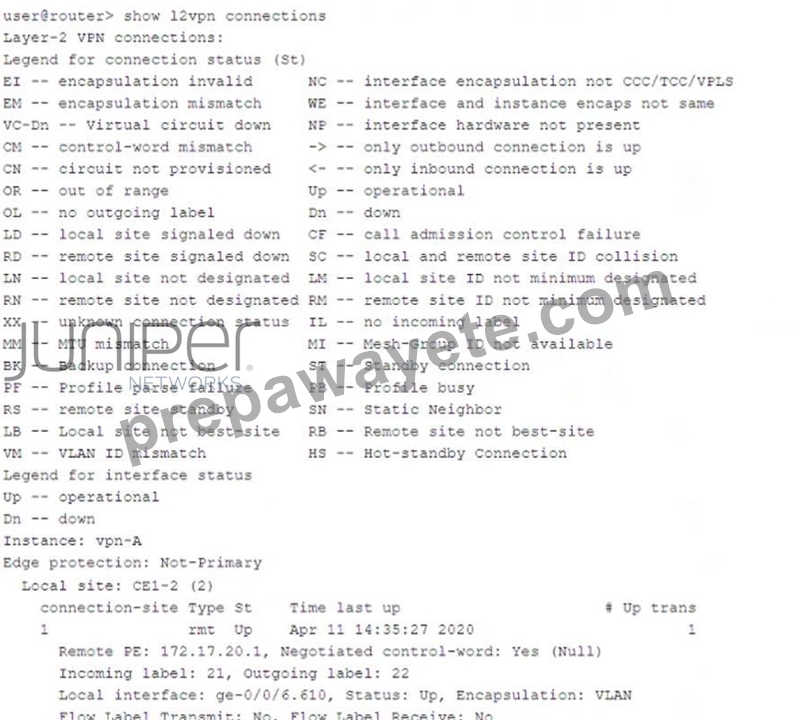
- A. The connection has not flapped since it was initiated.
- B. The PE router has the capability to pop flow labels.
- C. The PE is attached to a single local site.
- D. There has been a VLAN ID mismatch.
Answer: A,C
NEW QUESTION # 29
Referring to the exhibit, which two statements are true? (Choose two.)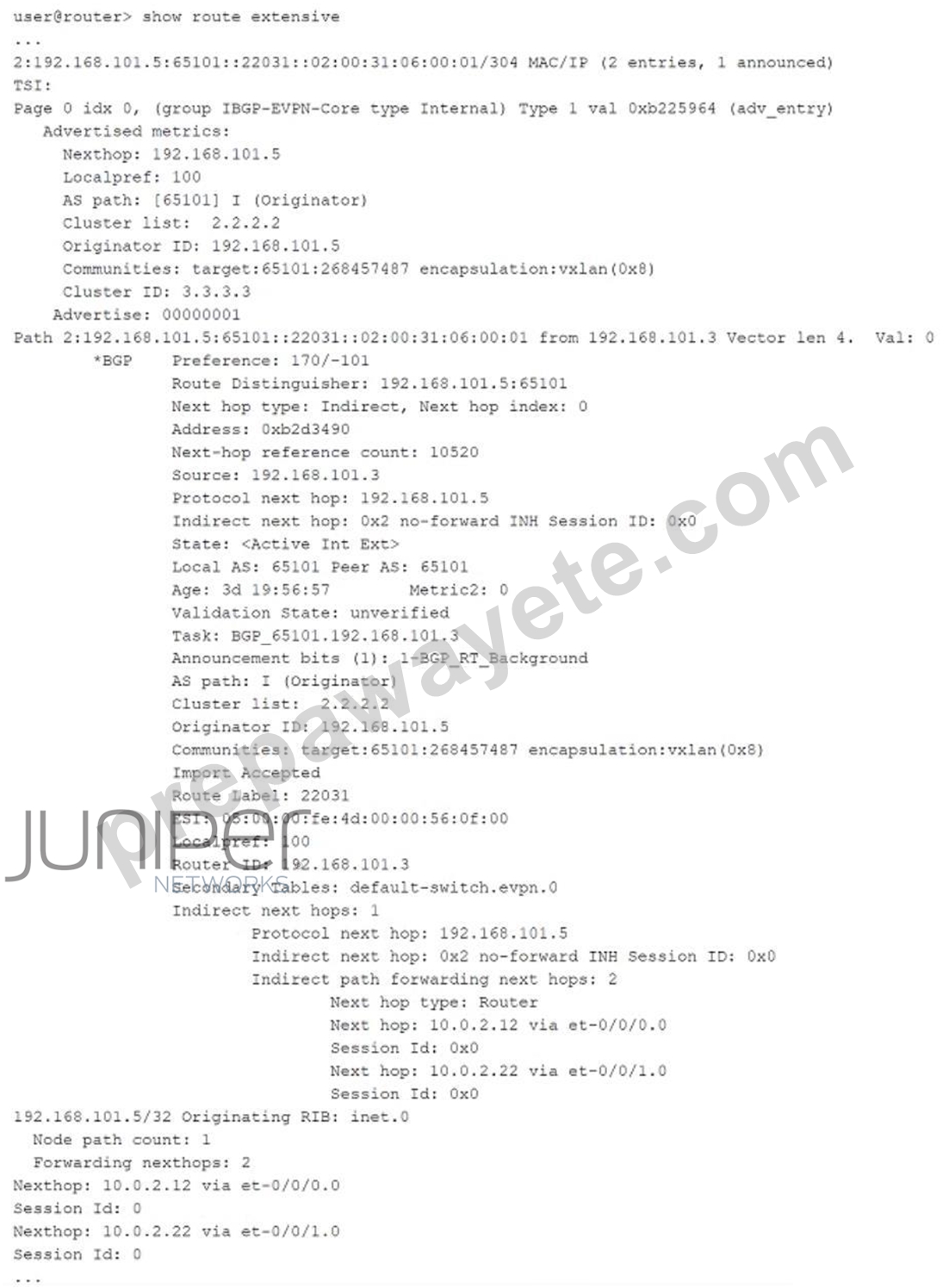
- A. The devices advertising this route into EVPN are 10.0.2.12 and 10.0.2.22.
- B. This route is learned through EBGP.
- C. The device advertising this route into EVPN is 192.168.101.5.
- D. This is an EVPN Type-2 route.
Answer: C,D
NEW QUESTION # 30
Exhibit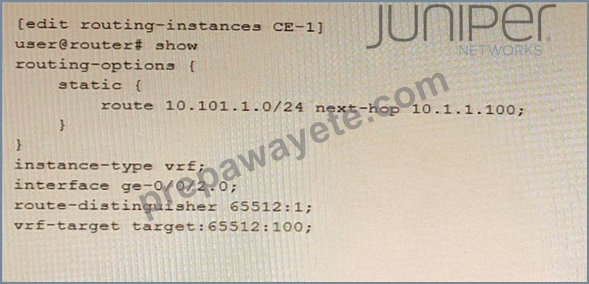
Referring to the exhibit, which statement is true?
- A. The 10.101.1.0/24 route will only be shared if BGP is configured in the routing instance
- B. The 10.101.1.0/24 route will be shared if the auto-export parameter is configured
- C. The 10.101.1 0/24 route will be shared if there are other VRFs that use the same route target community
- D. The 10.101.1.0/24 route will be shared if the vrf-table-label parameter is configured.
Answer: B
Explanation:
The auto-export parameter is a routing option that allows a routing instance to share routes with other routing instances or the master routing table. The auto-export parameter automatically exports routes from one routing instance to another based on the route target communities attached to the routes. In this scenario, the 10.101.1.0/24 route will be shared if the auto-export parameter is configured under [edit routing-options] hierarchy level.
NEW QUESTION # 31
Exhibit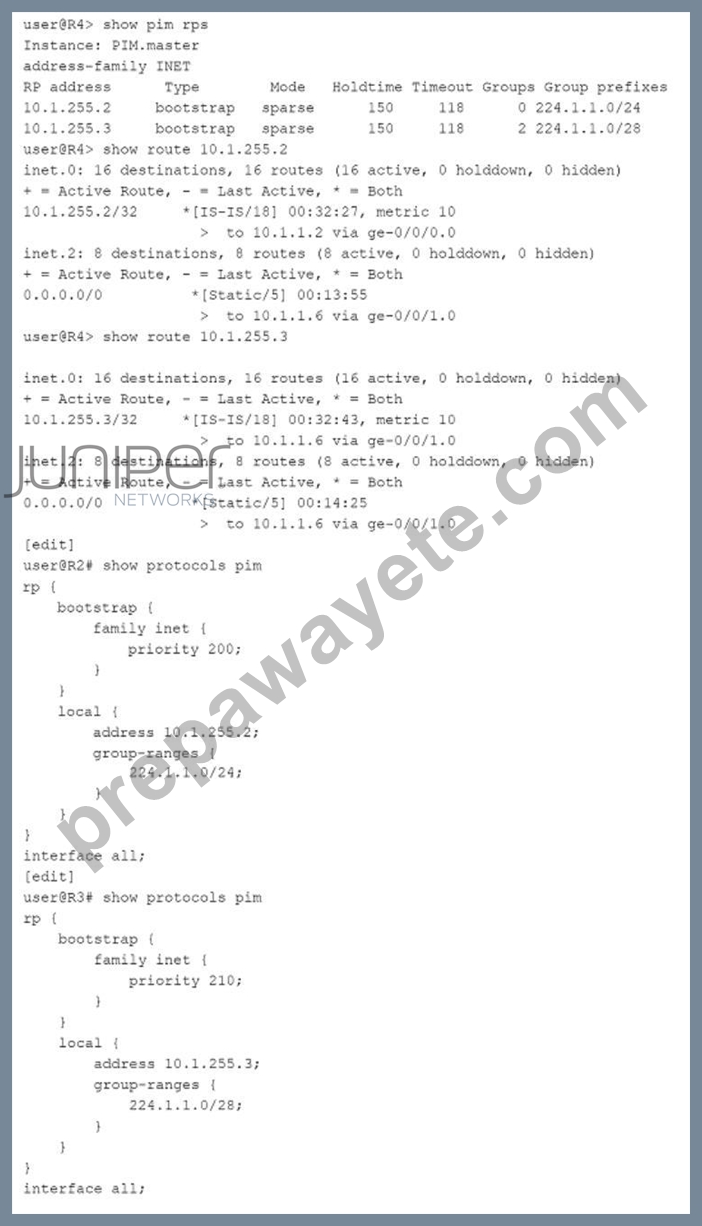
R4 is directly connected to both RPs (R2 and R3) R4 is currently sending all ,o,ns upstream to R3 but you want all joins to go to R2 instead Referring to the exhibit, which configuration change will solve this issue?
- A. Change the local address on R2 to be higher than R3.
- B. Change the group-range to be more specific on R2 than R3.
- C. Change the default route in inet.2 on R4 from R3 as the next hop to R2
- D. Change the bootstrap priority on R2 to be higher than R3
Answer: B
Explanation:
The issue arises because R3's group-range (224.1.1.0/28) is more specific than R2's group-range (224.1.1.0
/24). In PIM bootstrap (BSR), the RP with the longest prefix (most specific group-range) is preferred, regardless of priority. Even though R3 has a higher bootstrap priority (210 vs. R2's 200), its more specific
/28 group-range takes precedence for groups within 224.1.1.0/28.
Why Option D is Correct:
* To force R4 to use R2 for all joins, R2's group-range must be more specific than R3's. For example:
* If R2's group-range is changed to 224.1.1.0/28 (same as R3) but with a higher priority, R2 would win (priority is compared only when group-ranges are equal).
* If R2's group-range is changed to 224.1.1.0/29 (more specific than /28), it will override R3's
/28 for groups in the /29 range.
* The key is prefix specificity, which overrides priority in BSR elections.
Why Other Options Are Incorrect:
* A. Change bootstrap priority on R2 to be higher than R3:
* Priority is evaluated only when group-ranges are identical. Since R3's group-range (/28) is more specific than R2's (/24), R3 will still win for groups in 224.1.1.0/28, even if R2's priority is higher.
* B. Change the default route in inet.2 on R4:
* RPF routes (inet.2) determine how traffic reaches the RP, but they do not influence RP election logic (BSR priority/group-range).
* C. Change R2's local address to be higher than R3's:
* The RP address is a tiebreaker only if priorities and group-ranges are equal. Since R3's group- range is more specific, this change has no impact.
Key Takeaways:
* BSR RP Election Order:
* Longest group prefix (most specific).
* Highest priority (if prefixes are equal).
* Highest RP address (if prefixes and priorities are equal).
* To override R3, R2 must advertise a more specific group-range (e.g., /28 or smaller) to ensure it is selected for the desired multicast groups.
NEW QUESTION # 32
What is the correct order of packet flow through configurable components in the Junos OS CoS features?
- A. Behavior Aggregate Classifier -> Input Policer -> Multifield Classifier -> Forwarding Policy Options -> Fabric Scheduler -> Output Policer -> Scheduler/Shaper/RED -> Rewrite Marker
- B. Behavior Aggregate Classifier -> Multifield Classifier -> Input Policer -> Forwarding Policy Options -> Fabric Scheduler -> Output Policer -> Scheduler/Shaper/RED -> Rewrite Marker
- C. Behavior Aggregate Classifier -> Multifield Classifier -> Input Policer -> Forwarding Policy Options -> Fabric Scheduler -> Scheduler/Shaper/RED -> Output Policer -> Rewrite Marker
- D. Multifield Classifier -> Behavior Aggregate Classifier -> Input Policer -> Forwarding Policy Options -> Fabric Scheduler -> Output Policer -> Rewrite Marker -> Scheduler/Shaper/RED
Answer: A
Explanation:
The correct order of packet flow through configurable components in the Junos OS CoS features is as follows:
Behavior Aggregate Classifier: This component uses a single field in a packet header to classify traffic into different forwarding classes and loss priorities based on predefined or user-defined values.
Input Policer: This component applies rate-limiting and marking actions to incoming traffic based on the forwarding class and loss priority assigned by the classifier.
Multifield Classifier: This component uses multiple fields in a packet header to classify traffic into different forwarding classes and loss priorities based on user-defined values and filters.
Forwarding Policy Options: This component applies actions such as load balancing, filtering, or routing to traffic based on the forwarding class and loss priority assigned by the classifier.
Fabric Scheduler: This component schedules traffic across the switch fabric based on the forwarding class and loss priority assigned by the classifier.
Output Policer: This component applies rate-limiting and marking actions to outgoing traffic based on the forwarding class and loss priority assigned by the classifier.
Scheduler/Shaper/RED: This component schedules, shapes, and drops traffic at the egress interface based on the forwarding class and loss priority assigned by the classifier.
Rewrite Marker: This component rewrites the code-point bits of packets leaving an interface based on the forwarding class and loss priority assigned by the classifier.
NEW QUESTION # 33
Exhibit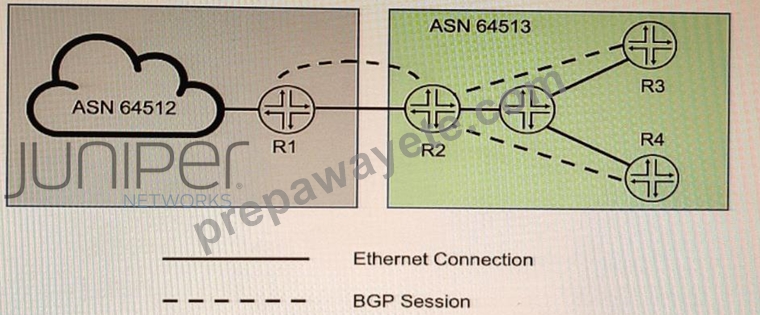
You want to implement the BGP Generalized TTL Security Mechanism (GTSM) on the network Which three statements are correct in this scenario? (Choose three)
- A. BGP GTSM requires a TTL of 255 to be configured between neighbors.
- B. You can implement BGP GTSM between R2, R3, and R4
- C. You can implement BGP GTSM between R2 and R1.
- D. BGP GTSM requires a firewall filter to discard packets with incorrect TTL.
- E. BGP GTSM requires a TTL of 1 to be configured between neighbors.
Answer: A,C,D
Explanation:
https://www.juniper.net/documentation/us/en/software/junos/bgp/topics/ref/statement/multihop-edit-protocols- bgp.html
NEW QUESTION # 34
Exhibit
Which two statements are true about the OSPF adjacency displayed in the exhibit? (Choose two.)
- A. There is a mismatch in the hello interval parameter between routers R1 and R2
- B. There is a mismatch in the dead interval parameter between routers R1 and R2.
- C. There is a mismatch in the OSPF hold timer parameter between routers R1 and R2.
- D. There is a mismatch in the poll interval parameter between routers R1 and R2.
Answer: A,B
Explanation:
The hello interval is the time interval between two consecutive hello packets sent by an OSPF router on an interface. The dead interval is the time interval after which a neighbor is declared down if no hello packets are received from it. These parameters must match between two OSPF routers for them to form an adjacency. In the exhibit, router R1 has a hello interval of 10 seconds and a dead interval of 40 seconds, while router R2 has a hello interval of 30 seconds and a dead interval of 120 seconds. This causes a mismatch and prevents them from becoming neighbors23.
NEW QUESTION # 35
Referring to the exhibit, which two statements are true? (Choose two.)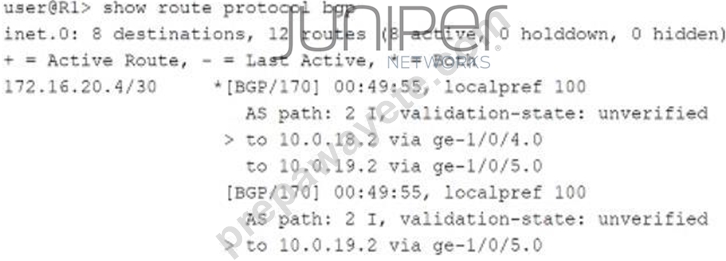
- A. This route is learned from the same AS number.
- B. The multipath configuration is used for load balancing.
- C. The multihop configuration is used for load balancing.
- D. This route is learned from two different AS numbers.
Answer: A,B
NEW QUESTION # 36
You have an OSPF environment. You have recently added a router called R4 that is directly connected to R1 and R2. You discover that R4 is only peering with R2.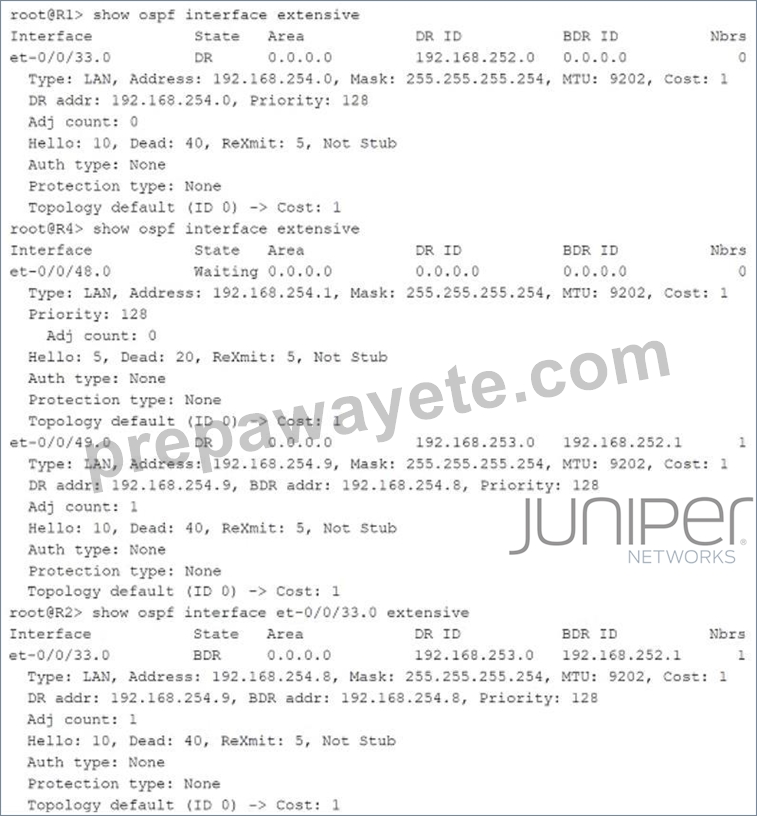
Referring to the exhibit, how would you correct the peering?
- A. Adjust the Dead Interval on R4 to match the Dead Interval on R1 and R2.
- B. Change the MTU size on R1 and R2 to be 22 bytes higher than R4's MTU size.
- C. Adjust the Priority on R1 to be lower than the Priority on R4.
- D. Adjust the Hello Interval on R1 and R2 to match the Hello Interval on R4.
Answer: D
NEW QUESTION # 37
Which two statements are correct about a sham link? (Choose two.)
- A. The PEs exchange Type 1 OSPF LSAs instead of Type 3 OSPF LSAs for the L3VPN routes
- B. It creates a BGP multihop neighborship between two PE routers.
- C. It creates an OSPF multihop neighborship between two PE routers.
- D. The PEs exchange Type 3 OSPF LSAs instead of Type 1 OSPF LSAs for the L3VPN routes.
Answer: A,C
Explanation:
https://www.juniper.net/documentation/us/en/software/junos/ospf/topics/topic-map/configuring-ospfv2-sham-links.html
NEW QUESTION # 38
You must alter class-of-service values in packets on the outbound interface of an edge router.
In this scenario, which CoS component allows you to accomplish this task?
- A. scheduler
- B. output policer
- C. rewrite rules
- D. forwarding classes
Answer: C
Explanation:
Class of Service (CoS) in networking is used to manage traffic by classifying, scheduling, and sometimes modifying packets to ensure network performance and Quality of Service (QoS). Different CoS components are used to achieve these goals. Let's analyze each option to determine which CoS component allows you to alter class-of-service values on the outbound interface of an edge router.
1. **Output Policer**:
- Policing is used to control the rate of traffic sent to or from a network interface. It can drop or remark traffic that exceeds a certain rate.
- Policing is not typically used to alter CoS values but to enforce traffic limits.
2. **Scheduler**:
- A scheduler is responsible for managing the order in which packets are transmitted out of an interface based on their CoS markings. It can allocate bandwidth and prioritize traffic.
- The scheduler manages how packets are queued and sent but does not alter the CoS values of packets.
3. **Rewrite Rules**:
- Rewrite rules are used to modify the CoS values of packets, such as DSCP (Differentiated Services Code Point) or 802.1p bits, as they exit an interface.
- Rewrite rules can alter the class-of-service values in the packet headers to match the desired policies of the outbound interface.
- Therefore, rewrite rules are the correct component for altering CoS values on an outbound interface.
4. **Forwarding Classes**:
- Forwarding classes are used to categorize packets into different traffic classes within a router for QoS handling.
- They help in defining how packets should be treated by the scheduler but do not directly modify the CoS values.
**Conclusion**:
To alter class-of-service values in packets on the outbound interface of an edge router, the correct CoS component to use is:
**C. rewrite rules**
**Reference**:
- Juniper Networks Documentation on CoS: [Class of Service Overview](https://www.juniper.net/documentation/en_US/junos/topics/concept/class-of-service-overview.html)
- Junos OS CoS Configuration Guide: [Rewrite Rules](https://www.juniper.net/documentation/en_US/junos/topics/topic-map/class-of-service-rewrite-rules.html)
NEW QUESTION # 39
Which two statements are correct about the customer interface in an LDP-signaled pseudowire?
(Choose two.)
- A. When the encapsulation is vlan-ccc or extended-vlan-ccc, the configured VLAN tag is included in the control plane LDP advertisement.
- B. When the encapsulation is ethernet-ccc, only frames without a VLAN tag are accepted in the data plane.
- C. When the encapsulation is vlan-ccc or extended-vlan-ccc, the configured VLAN tag is not included in the control plane LDP advertisement.
- D. When the encapsulation is ethernet-ccc, tagged and untagged frames are both accepted in the data plane.
Answer: A,D
NEW QUESTION # 40
Exhibit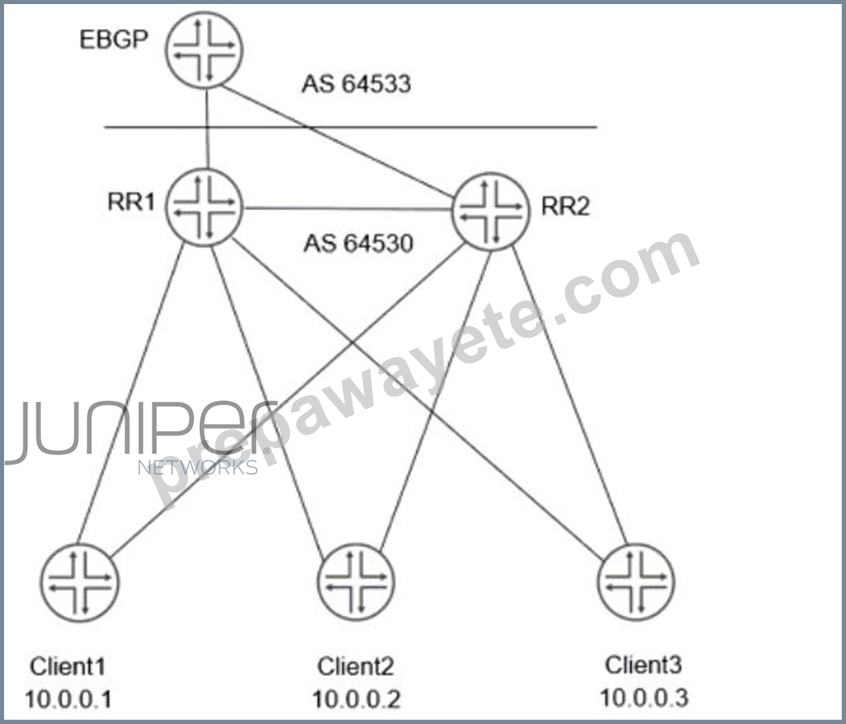
Referring to the exhibit, which two statements are correct about the dual route reflectors within a cluster? (Choose two.)
- A. RR1 and RR2 must have the same duster ID to exchange routes learned from the client.
- B. RR1 and RR2 advertise routes learned from the clients to EBGP peers, using itself as the next hop.
- C. RR1 and RR2 append the duster ID when advertising routes from dient to dient.
- D. RR1 advertises routes from the client to RR2. using itself as the next hop.
Answer: B,C
NEW QUESTION # 41
Exhibit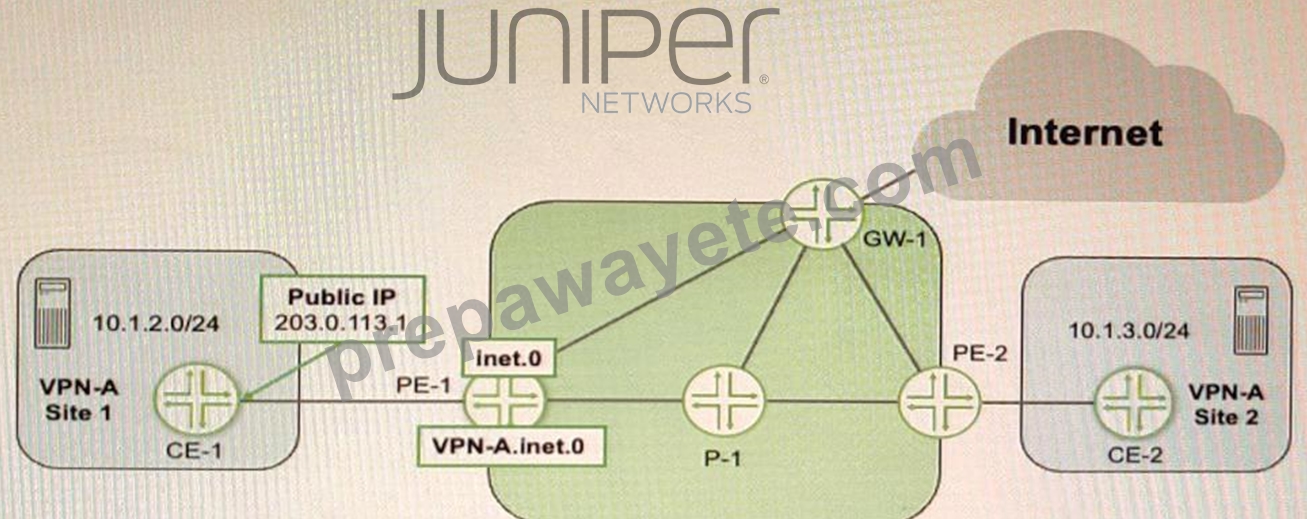
Referring to the exhibit, CE-1 is providing NAT services for the hosts at Site 1 and you must provide Internet access for those hosts Which two statements are correct in this scenario? (Choose two.)
- A. You must configure a RIB group on PE-1 to leak a default route from the inet.0 table to the VPN-A.inet.0 table.
- B. You must configure a static route in the main routing instance for the 203.0.113.1/32 prefix that uses the VPN-A.inet.0 table as the next hop.
- C. You must configure a static route in the main routing instance for the 10 1 2.0/24 prefix that uses the VPN-A.inet.0 table as the next hop
- D. You must configure a RIB group on PE-1 to leak the 10 1 2.0/24 prefix from the VPN-A.inet.0 table to the inet.0 table.
Answer: A,B
NEW QUESTION # 42
Exhibit.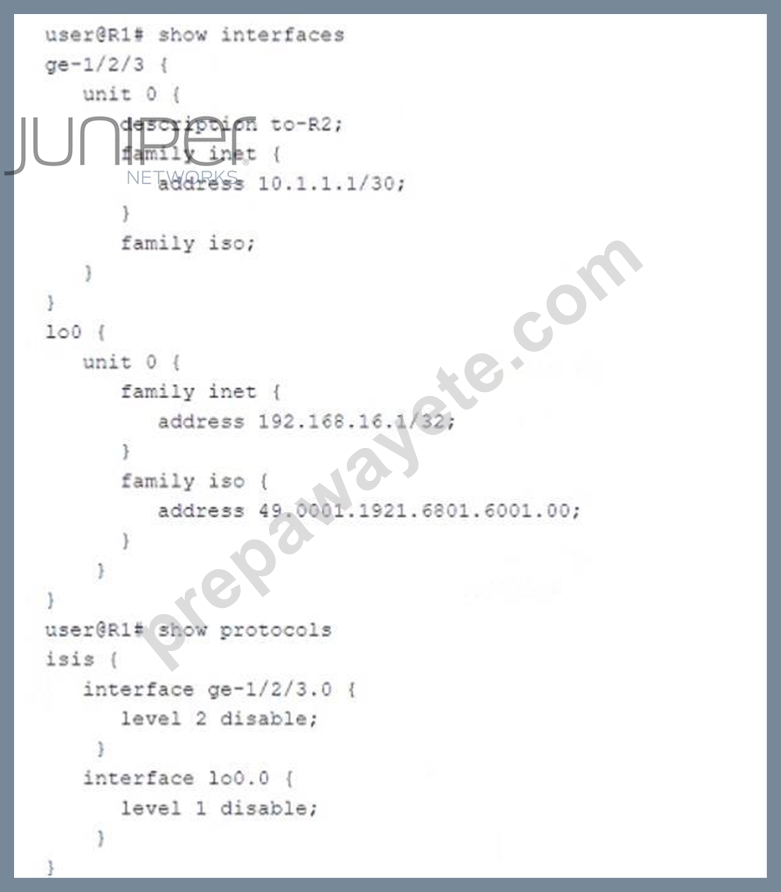
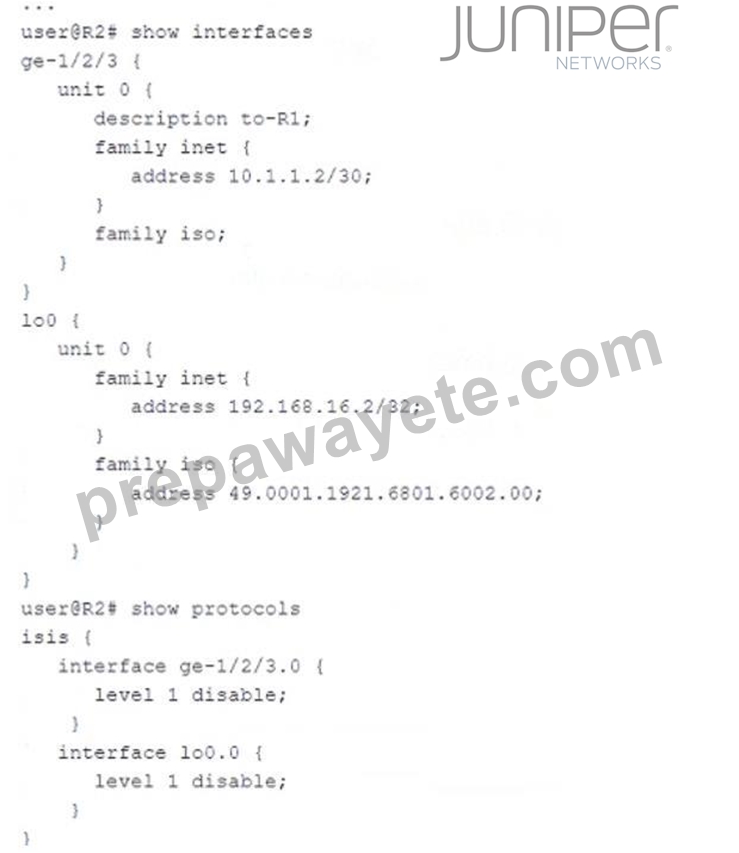
Referring to the exhibit, what must be changed to establish a Level 1 adjacency between routers R1 and R2?
- A. Change the level 1 disable parameter under the R2 protocols isis interface ge-l/2/3.0 hierarchy to the level 2 disable parameter.
- B. Add IP addresses to the interface ge-1/2/3 unit 0 family iso hierarchy on both R1 and R2.
- C. Remove the level 1 disable parameter under the R2 protocols isis interface lo0.0 configuration hierarchy.
- D. Change the level l disable parameter under the R1 protocols isis interface lo0.0 hierarchy to the level 2 disable parameter.
Answer: A
NEW QUESTION # 43
You are configuring anycast RP for load balancing and redundancy in your PIM-SM domain. You want to share active sources between RPs.
In this scenario, what are two solutions that will accomplish this task? (Choose two.)
- A. Configure MSDP on each RP router.
- B. Configure anycast PIM with the rp-set statement on each RP router.
- C. Configure anycast PIM with the rp-set statement on each source DR router.
- D. Configure MSDP on each source DR router.
Answer: A,B
NEW QUESTION # 44
Exhibit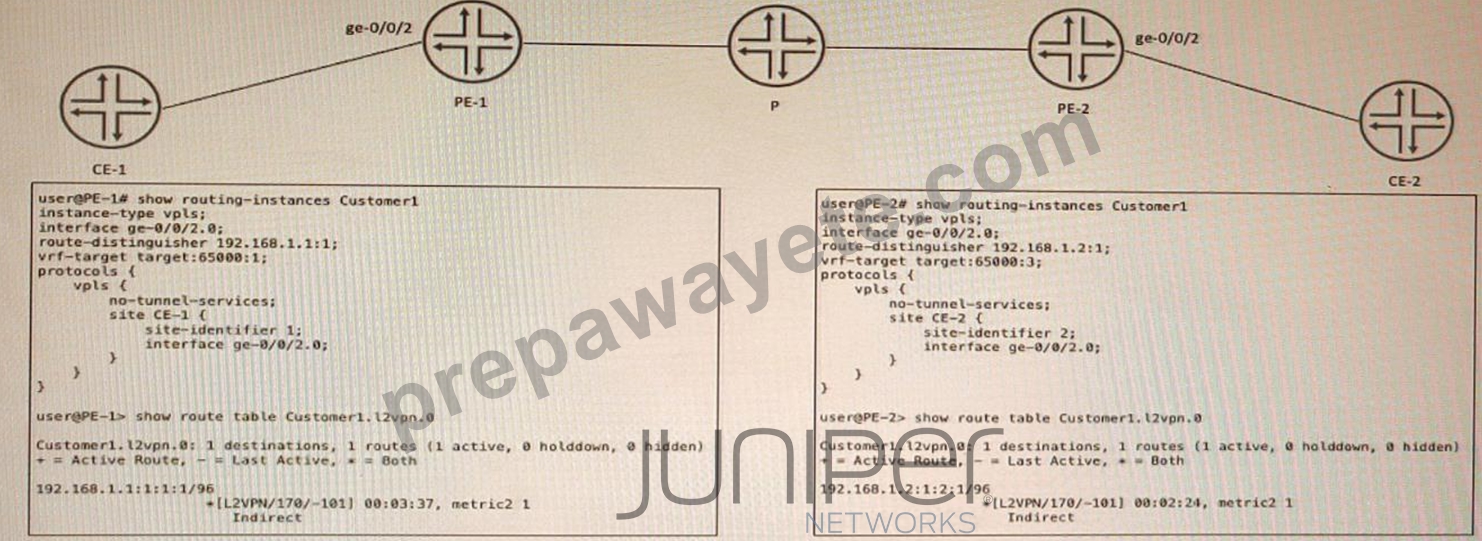
CE-1 and CE-2 are part of a VPLS called Customer1 No connectivity exists between CE-1 and CE-2. In the process of troubleshooting, you notice PE-1 is not learning any routes for this VPLS from PE-2, and PE-2 is not learning any routes for this VPLS from PE-1.
- A. The instance type should be changed to I2vpn.
- B. The no-tunnel-services statement should be deleted on both PEs.
- C. The route target must match on PE-1 and PE-2.
- D. The route distinguisher must match on PE-1 and PE-2.
Answer: C
Explanation:
VPLS is a technology that provides Layer 2 VPN services over an MPLS network. VPLS uses BGP as its control protocol to exchange VPN membership information between PE routers. The route target is a BGP extended community attribute that identifies which VPN a route belongs to. The route target must match on PE routers that participate in the same VPLS instance, otherwise they will not accept or advertise routes for that VPLS.
NEW QUESTION # 45
Exhibit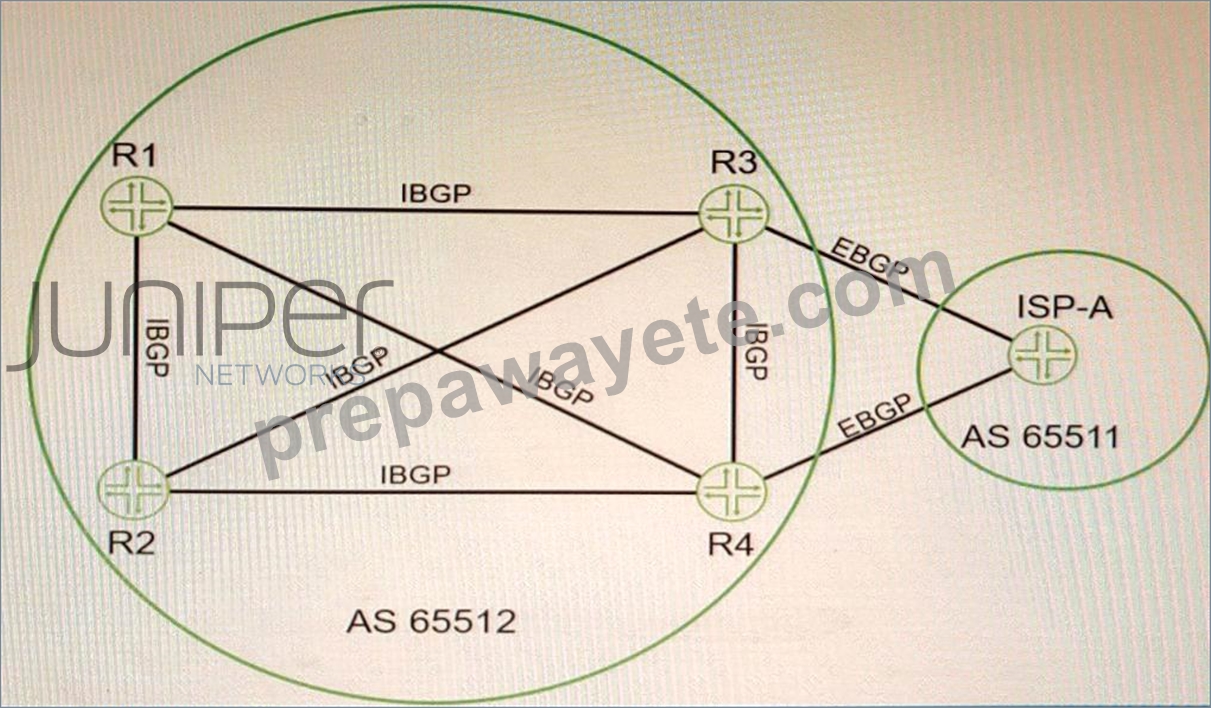
Click the Exhibit button-Referring to the exhibit, which two statements are correct about BGP routes on R3 that are learned from the ISP-A neighbor? (Choose two.)
- A. All BGP attribute values must be removed before receiving the routes.
- B. The BGP local-preference value that is used by ISP-A is not advertised to R3.
- C. The next-hop value for these routes is changed by ISP-A before being sent to R3.
- D. By default, the next-hop value for these routes is not changed by ISP-A before being sent to R3.
Answer: B,D
Explanation:
BGP is an exterior gateway protocol that uses path vector routing to exchange routing information among autonomous systems. BGP uses various attributes to select the best path to each destination and to propagate routing policies. Some of the common BGP attributes are AS path, next hop, local preference, MED, origin, weight, and community. BGP attributes can be classified into four categories: well-known mandatory, well-known discretionary, optional transitive, and optional nontransitive. Well-known mandatory attributes are attributes that must be present in every BGP update message and must be recognized by every BGP speaker.
Well-known discretionary attributes are attributes that may or may not be present in a BGP update message but must be recognized by every BGP speaker. Optional transitive attributes are attributes that may or may not be present in a BGP update message and may or may not be recognized by a BGP speaker. If an optional transitive attribute is not recognized by a BGP speaker, it is passed along to the next BGP speaker. Optional nontransitive attributes are attributes that may or may not be present in a BGP update message and may or may not be recognized by a BGP speaker. If an optional nontransitive attribute is not recognized by a BGP speaker, it is not passed along to the next BGP speaker. In this question, we have four routers (R1, R2, R3, and R4) that are connected in a full mesh topology and running IBGP. R3 receives the 192.168.0.0/16 route from its EBGP neighbor and advertises it to R1 and R4 with different BGP attribute values. We are asked which statements are correct about the BGP routes on R3 that are learned from the ISP-A neighbor. Based on the information given, we can infer that the correct statements are:
By default, the next-hop value for these routes is not changed by ISP-A before being sent to R3. This is because the default behavior of EBGP is to preserve the next-hop attribute of the routes received from another EBGP neighbor. The next-hop attribute indicates the IP address of the router that should be used as the next hop to reach the destination network.
The BGP local-preference value that is used by ISP-A is not advertised to R3. This is because the local-preference attribute is a well-known discretionary attribute that is used to influence the outbound traffic from an autonomous system. The local-preference attribute is only propagated within an autonomous system and is not advertised to external neighbors.
References: : https://www.cisco.com/c/en/us/support/docs/ip/border-gateway-protocol-bgp/13753-25.html :
https://www.cisco.com/c/en/us/support/docs/ip/border-gateway-protocol-bgp/13762-40.html :
https://www.cisco.com/c/en/us/support/docs/ip/border-gateway-protocol-bgp/13759-37.html
NEW QUESTION # 46
Which statement is true regarding BGP FlowSpec?
- A. It uses a remote triggered black hole to protect a network from a denial-of-service attack.
- B. It verifies that the source IP of the incoming packet has a resolvable route in the routing table.
- C. It is used to protect a network from denial-of-service attacks dynamically.
- D. It uses dynamically created routing policies to protect a network from denial-of-service attacks.
Answer: C
NEW QUESTION # 47
You must alter class-of-service values in packets on the outbound interface of an edge router.
In this scenario, which CoS component allows you to accomplish this task?
- A. scheduler
- B. output policer
- C. rewrite rules
- D. forwarding classes
Answer: C
Explanation:
Class of Service (CoS) in networking is used to manage traffic by classifying, scheduling, and sometimes modifying packets to ensure network performance and Quality of Service (QoS). Different CoS components are used to achieve these goals. Let's analyze each option to determine which CoS component allows you to alter class-of-service values on the outbound interface of an edge router.
1. **Output Policer**:
- Policing is used to control the rate of traffic sent to or from a network interface. It can drop or remark traffic that exceeds a certain rate.
- Policing is not typically used to alter CoS values but to enforce traffic limits.
2. **Scheduler**:
- A scheduler is responsible for managing the order in which packets are transmitted out of an interface based on their CoS markings. It can allocate bandwidth and prioritize traffic.
- The scheduler manages how packets are queued and sent but does not alter the CoS values of packets.
3. **Rewrite Rules**:
- Rewrite rules are used to modify the CoS values of packets, such as DSCP (Differentiated Services Code Point) or 802.1p bits, as they exit an interface.
- Rewrite rules can alter the class-of-service values in the packet headers to match the desired policies of the outbound interface.
- Therefore, rewrite rules are the correct component for altering CoS values on an outbound interface.
4. **Forwarding Classes**:
- Forwarding classes are used to categorize packets into different traffic classes within a router for QoS handling.
- They help in defining how packets should be treated by the scheduler but do not directly modify the CoS values.
**Conclusion**:
To alter class-of-service values in packets on the outbound interface of an edge router, the correct CoS component to use is:
**C. rewrite rules**
**References**:
- Juniper Networks Documentation on CoS: [Class of Service
Overview](https://www.juniper.net/documentation/en_US/junos/topics/concept/class-of-service-overview.html)
- Junos OS CoS Configuration Guide: [Rewrite
Rules](https://www.juniper.net/documentation/en_US/junos/topics/topic-map/class-of-service-rewrite-rules.html
NEW QUESTION # 48
Which two statements describe PIM-SM? (Choose two)
- A. Traffic is initially flooded to all routers and an S,G is maintained for each group
- B. Traffic is only forwarded to routers that request to join the distribution tree.
- C. Routers with receivers send join messages to their upstream neighbors.
- D. Routers without receivers must periodically prune themselves from the SPT.
Answer: B,C
Explanation:
Explanation
PIM sparse mode (PIM-SM) is a multicast routing protocol that uses a pull model to deliver multicast traffic.
In PIM-SM, routers with receivers send join messages to their upstream neighbors toward a rendezvous point (RP) or a source-specific tree (SPT). The RP or SPT acts as the root of a shared distribution tree for a multicast group. Traffic is only forwarded to routers that request to join the distribution tree by sending join messages.
PIM-SM does not flood traffic to all routers or prune routers without receivers, as PIM dense mode does.
NEW QUESTION # 49
Exhibit
You have MAC addresses moving in your EVPN environment
Referring to the exhibit, which two statements are correct about the sequence number? (Choose two)
- A. It identifies MAC addresses that should be discarded.
- B. It is advertised using a Type 2 message
- C. It resolves conflicting MAC address ownership claims.
- D. It helps the local PE to identify the latest advertisement.
Answer: C,D
Explanation:
The sequence number is a field in the MAC mobility extended community that is used to resolve conflicting MAC address ownership claims and to help the local PE to identify the latest advertisement. The sequence number is incremented by one for every MAC address mobility event, such as when a host moves from one Ethernet segment to another segment in the EVPN network. The PE device that receives multiple MAC advertisements for the same MAC address chooses the one with the highest sequence number as the most recent and valid advertisement.
NEW QUESTION # 50
Exhibit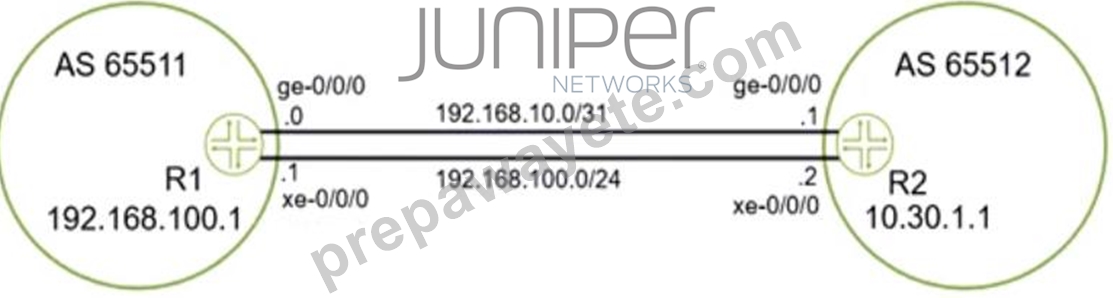
You want to use both links between R1 and R2 Because of the bandwidth difference between the two links, you must ensure that the links are used as much as possible.
Which action will accomplish this goal?
- A. Ensure that the metric-out parameter on the Gigabit Ethernet interface is higher than the 10 Gigibit Ethernet interface.
- B. Enable per-prefix load balancing.
- C. Disable multipath.
- D. Define a policy to tag routes with the appropriate bandwidth community.
Answer: D
Explanation:
https://www.juniper.net/documentation/us/en/software/junos/sampling-forwarding-monitoring/bgp/topics/concept/bgp-multipath-unequal-understanding.html
NEW QUESTION # 51
Exhibit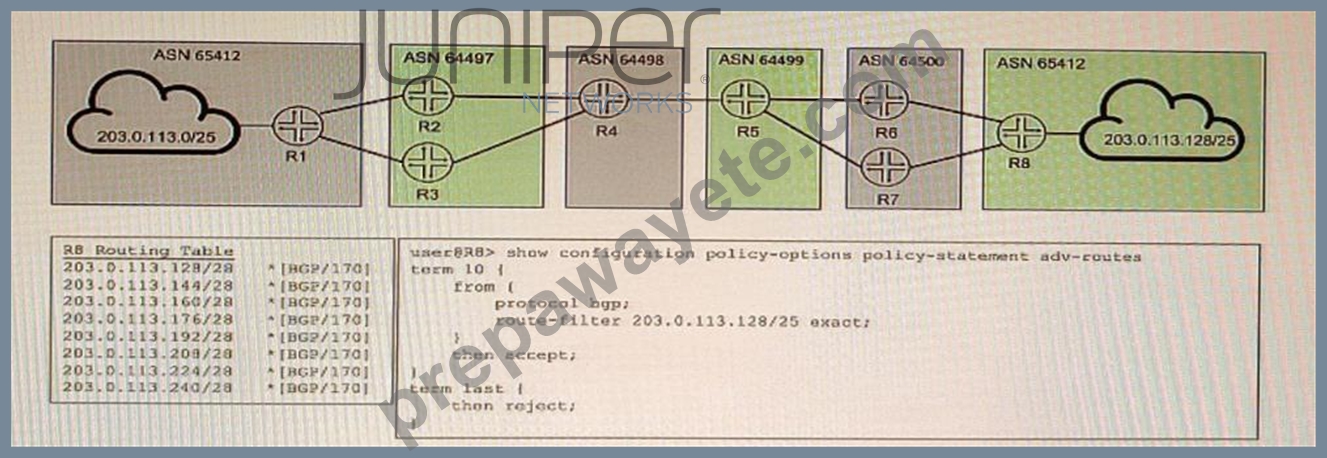
You are attempting to summarize routes from the 203.0.113.128/25 IP block on R8 to AS 64500. You implement the export policy shown in the exhibit and all routes from the routing table stop being advertised.
In this scenario, which two steps would you take to summarize the route in BGP? (Choose two.)
- A. Add the set routing-options static route 203.0.113.123/25 discard command.
- B. Replace exact in the export policy with orlonger.
- C. Add the set protocols bgp family inet unicast add-path command to allow additional routes to the RIB tables. -
- D. Remove the from protocol bgp command from the export policy.
Answer: A,B
Explanation:
Explanation
To summarize routes from the 203.0.113.128/25 IP block on R8 to AS 64500, you need to do the following:
* Add the set routing-options static route 203.0.113.128/25 discard command. This creates a static route for the summary prefix and discards any traffic destined to it. This is necessary because BGP can only advertise routes that are present in the routing table.
* Replace exact in the export policy with orlonger. This allows R8 to match and advertise any route that is equal or more specific than the summary prefix. The exact term only matches routes that are exactly equal to the summary prefix, which is not present in the routing table.
NEW QUESTION # 52
......
Powerful JN0-664 PDF Dumps for JN0-664 Questions: https://www.prepawayete.com/Juniper/JN0-664-practice-exam-dumps.html
Authentic JN0-664 Dumps - Free PDF Questions to Pass: https://drive.google.com/open?id=13IZ1S_sjt2GvR5Zk07zRH8Xf7_becgDP