

[Oct 17, 2023] 100% Latest Most updated MS-500 Questions and Answers
Try with 100% Real Exam Questions and Answers
What are the duration, language, format, passing score, and questions for the Microsoft MS-500 certification exam?
The Microsoft MS-500 exam is a 2 hours long, multiple-choice-based test.
Internationally, the language of the Microsoft MS-500 exam is English, Chinese (Simplified), Korean, French, Spanish, Portuguese (Brazil), Russian, Chinese (Traditional), Italian, Arabic (Saudi Arabia), Japanese, German.
The format of the Microsoft MS-500 exam is a computer-based test (CBT). Fundamentals of computer networking and security are provided.
The passing score for passing the Microsoft MS-500 certification exam and getting a Certificate is 700 out of 1000 possible points. Researched questions are provided to students. Securing the Microsoft MS-500 certification exam is not easy, and it usually takes at least six months to achieve this difficult goal.
In order to successfully pass the MS-500 exam, candidates should have a strong understanding of Microsoft 365 security technologies and should be able to demonstrate their ability to implement and manage these solutions effectively. Candidates who pass the exam will earn the Microsoft 365 Certified: Security Administrator Associate certification, which is recognized globally and can help IT professionals advance their careers in the field of security administration.
NEW QUESTION # 131
Note: This question is part of series of questions that present the same scenario. Each question in the series contains a unique solution that might meet the stated goals. Some question sets might have more than one correct solution, while others might not have a correct solution.
After you answer a question in this section, you will NOT be able to return to it. As a result, these questions will not appear in the review screen.
You have a Microsoft 365 E5 subscription that is associated to a Microsoft Azure Active Directory (Azure AD) tenant named contoso.com.
You use Active Directory Federation Services (AD FS) to federate on-premises Active Directory and the tenant. Azure AD Connect has the following settings:
Source Anchor: objectGUID
Password Hash Synchronization: Disabled
Password writeback: Disabled
Directory extension attribute sync: Disabled
Azure AD app and attribute filtering: Disabled
Exchange hybrid deployment: Disabled
User writeback: Disabled
You need to ensure that you can use leaked credentials detection in Azure AD Identity Protection.
Solution: You modify the Azure AD app and attribute filtering settings.
Does that meet the goal?
- A. Yes
- B. No
Answer: B
NEW QUESTION # 132
You have a Microsoft 365 subscription that uses an Azure Active Directory (Azure AD) tenant named contoso.com. OneDrive stores files that are shared with external users. The files are configured as shown in the following table.
You create a data loss prevention (DLP) policy that applies to the content stored in OneDrive accounts. The policy contains the following three rules:
* Rulel:
* Conditions: Label 1, Detect content that's shared with people outside my organization
* Actions: Restrict access to the content for external users
* User notifications: Notify the user who last modified the content
* User overrides: On
* Priority: 0
* Rule2:
* Conditions: Label 1 or Label2
* Actions: Restrict access to the content
* Priority: 1
* Rule3:
* Conditions: Label2, Detect content that's shared with people outside my organization
* Actions: Restrict access to the content for external users
* User notifications: Notify the user who last modified the content
* User overrides: On
* Priority: 2
For each of the following statements, select Yes if the statement is true. Otherwise, select No.
NOTE: Each correct selection is worth one point.
For each of the following statements, select Yes if the statement is true. Otherwise, select No. NOTE: Each correct selection is worth one point.
Answer:
Explanation:
Explanation
NEW QUESTION # 133
You have a Microsoft 365 subscription that uses a default domain name of contoso.com.
The multi-factor authentication (MFA) service settings are configured as shown in the exhibit. (Clock the Exhibit tab.)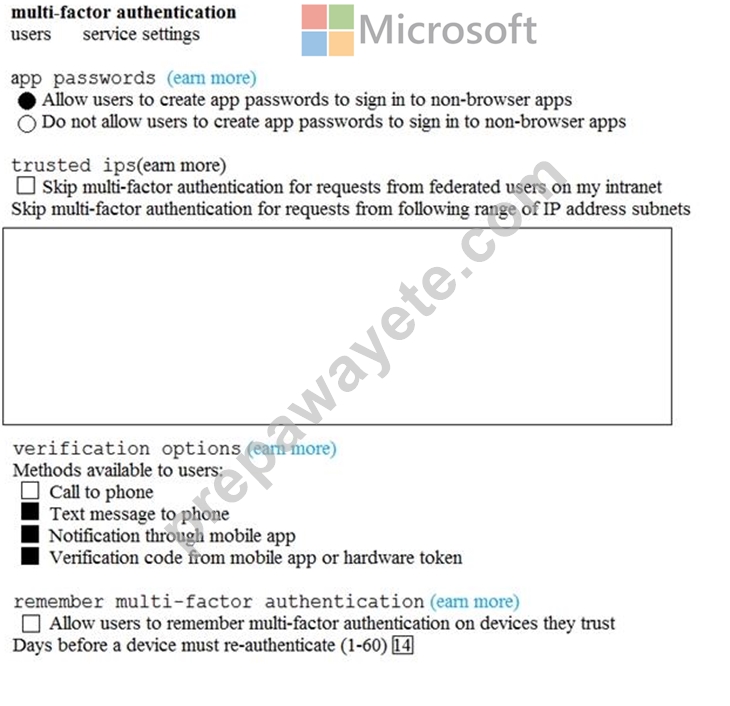
In contoso.com, you create the users shown in the following table.
What is the effect of the configuration? To answer, select the appropriate options in the answer area.
NOTE: Each correct selection is worth one point.
Answer:
Explanation:
NEW QUESTION # 134
You have a Microsoft 365 subscription.
You create a retention policy and apply the policy to Exchange Online mailboxes.
You need to ensure that the retention policy tags can be assigned to mailbox items as soon as possible.
What should you do?
- A. From the Security & Compliance admin center, create a data loss prevention (DLP) policy
- B. From Exchange Online PowerShell, run Start-RetentionAutoTagLearning
- C. From the Security & Compliance admin center, create a label policy
- D. From Exchange Online PowerShell, run Start-ManagedFolderAssistant
Answer: C
Explanation:
Explanation
References:
https://docs.microsoft.com/en-us/office365/securitycompliance/labels
NEW QUESTION # 135
You have a Microsoft 365 subscription that has Enable Security defaults set to No in Azure Active Directory (Azure AD).
You have a custom compliance manager template named Regulation1.
You have the assessments shown in the following table.
Assessment1 has the improvement actions shown in the following table.
Assessment2 has the improvement actions shown in the following table.
You perform the following actions:
For Assessment2, change the Test status of Establish a threat intelligence program to Implemented.
Enable multi-factor authentication (MFA) for all users.
Configure a privileged access policy.
For each of the following statements, select Yes if the statement is true. Otherwise, select No.
NOTE: Each correct selection is worth one point.
Answer:
Explanation:
Reference:
https://docs.microsoft.com/en-us/microsoft-365/compliance/compliance-manager-setup?view=o365-worldwide
https://docs.microsoft.com/en-us/microsoft-365/compliance/compliance-manager-improvement-actions?view=o365-worldwide
NEW QUESTION # 136
Which role should you assign to User1?
- A. Global administrator
- B. Security administrator
- C. Privileged role administrator
- D. User administrator
Answer: B
Explanation:
Explanation
https://docs.microsoft.com/en-us/azure/active-directory/privileged-identity-management/pim-how-to-give-acces
NEW QUESTION # 137
You have a Microsoft 365 subscription that uses a default domain name of contoso.com.
The multi-factor authentication (MFA) service settings are configured as shown in the exhibit. (Clock the Exhibit tab.)
In contoso.com, you create the users shown in the following table.
What is the effect of the configuration? To answer, select the appropriate options in the answer area.
NOTE: Each correct selection is worth one point.
Answer:
Explanation:
Explanation
NEW QUESTION # 138
You install Azure ATP sensors on domain controllers.
You add a member to the Domain Admins group. You view the timeline in Azure ATP and discover that information regarding the membership change is missing.
You need to meet the security requirements for Azure ATP reporting.
What should you configure? To answer, select the appropriate options in the answer area.
NOTE: Each correct selection is worth one point.
Answer:
Explanation:
Explanation
References:
https://docs.microsoft.com/en-us/azure-advanced-threat-protection/atp-advanced-audit-policy
NEW QUESTION # 139
Note: This question is part of series of questions that present the same scenario. Each question in
the series contains a unique solution that might meet the stated goals. Some question sets might
have more than one correct solution, while others might not have a correct solution.
After you answer a question in this section, you will NOT be able to return to it. As a result, these
questions will not appear in the review screen.
You have a Microsoft 365 E5 subscription that is associated to a Microsoft Azure Active Directory (Azure
AD) tenant named contoso.com.
You use Active Directory Federation Services (AD FS) to federate on-premises Active Directory and the
tenant. Azure AD Connect has the following settings:
Source Anchor: objectGUID
Password Hash Synchronization: Disabled
Password writeback: Disabled
Directory extension attribute sync: Disabled
Azure AD app and attribute filtering: Disabled
Exchange hybrid deployment: Disabled
User writeback: Disabled
You need to ensure that you can use leaked credentials detection in Azure AD Identity Protection.
Solution: You modify the Azure AD app and attribute filtering settings.
Does that meet the goal?
- A. Yes
- B. No
Answer: B
NEW QUESTION # 140
You view Compliance Manager as shown in the following exhibit.
Use the drop-down menus to select the answer choice that completes each statement based on the information presented in the graphic.
NOTE: Each correct selection is worth one point.
Answer:
Explanation:
Reference:
https://docs.microsoft.com/en-us/office365/securitycompliance/meet-data-protection-and-regulatory-reqs-using-microsoft-cloud
NEW QUESTION # 141
Please wait while the virtual machine loads. Once loaded, you may proceed to the lab section. This may take a few minutes, and the wait time will not be deducted from your overall test time.
When the Next button is available, click it to access the lab section. In this section, you will perform a set of tasks in a live environment. While most functionality will be available to you as it would be in a live environment, some functionality (e.g., copy and paste, ability to navigate to external websites) will not be possible by design.
Scoring is based on the outcome of performing the tasks stated in the lab. In other words, it doesn't matter how you accomplish the task, if you successfully perform it, you will earn credit for that task.
Labs are not timed separately, and this exam may more than one lab that you must complete. You can use as much time as you would like to complete each lab. But, you should manage your time appropriately to ensure that you are able to complete the lab(s) and all other sections of the exam in the time provided.
Please note that once you submit your work by clicking the Next button within a lab, you will NOT be able to return to the lab.
Username and password
Use the following login credentials as needed:
To enter your username, place your cursor in the Sign in box and click on the username below.
To enter your password, place your cursor in the Enter password box and click on the password below.
Microsoft 365 Username:
admin@[email protected]
Microsoft 365 Password: #HSP.ug?$p6un
If the Microsoft 365 portal does not load successfully in the browser, press CTRL-K to reload the portal in a new browser tab.
The following information is for technical support only:
Lab instance: 11122308


You need to ensure that a user named Allan Deyoung can perform searches and place holds on mailboxes, SharePoint Online sites, and OneDrive for Business locations. The solution must use the principle of least privilege.
To complete this task, sign in to the Microsoft 365 admin center.
Answer:
Explanation:
See explanation below.
Explanation
* After signing in to the Microsoft 365 admin center, navigate to the Security & Compliance Center.
* In the left pane of the security and compliance center, select Permissions, and then select the checkbox next to eDiscovery Manager.
* On the eDiscovery Manager flyout page, do one of the following based on the eDiscovery permissions that you want to assign.
To make a user an eDiscovery Manager: Next to eDiscovery Manager, select Edit. In the Choose eDiscovery Manager section, select the Choose eDiscovery Manager hyperlink, and then select + Add.
Select the user (or users) you want to add as an eDiscovery manager, and then select Add. When you're finished adding users, select Done. Then, on the Editing Choose eDiscovery Manager flyout page, select Save to save the changes to the eDiscovery Manager membership.
Reference:
https://docs.microsoft.com/en-us/microsoft-365/compliance/assign-ediscovery-permissions?view=o365-worldwi
NEW QUESTION # 142
Your company has 500 computers.
You plan to protect the computers by using Windows Defender Advanced Threat Protection (Windows Defender ATP). Twenty of the computers belong to company executives.
You need to recommend a remediation solution that meets the following requirements:
Windows Defender ATP administrators must manually approve all remediation for the executives
Remediation must occur automatically for all other users
What should you recommend doing from Windows Defender Security Center?
- A. Download an offboarding package for the computers of the 20 executives
- B. Create two machine groups
- C. Configure two alert notification rules
- D. Configure 20 system exclusions on automation allowed/block lists
Answer: B
Explanation:
Explanation/Reference:
Reference:
https://docs.microsoft.com/en-us/windows/security/threat-protection/windows-defender-atp/machine- groups-windows-defender-advanced-threat-protection Question Set 1
NEW QUESTION # 143
Your company has a Microsoft 365 subscription, a Microsoft Azure subscription, and an Azure Active Directory (Azure AD) tenant named contoso.com.
The company has the offices shown in the following table.
The tenant contains the users shown in the following table.
You create the Microsoft Cloud App Security policy shown in the following exhibit.
For each of the following statements, select Yes if the statement is true. Otherwise, select No.
NOTE: Each correct selection is worth one point.
Answer:
Explanation:
NEW QUESTION # 144
You have a Microsoft 365 subscription.
You identify the following data loss prevention (DLP) requirements:
Send notifications to users if they attempt to send attachments that contain EU social security numbers Prevent any email messages that contain credit card numbers from being sent outside your organization Block the external sharing of Microsoft OneDrive content that contains EU passport numbers Send administrators email alerts if any rule matches occur.
What is the minimum number of DLP policies and rules you must create to meet the requirements? To answer, select the appropriate options in the answer area.
NOTE: Each correct selection is worth one point.
Answer:
Explanation:
NEW QUESTION # 145
You have a Microsoft 365 subscription that uses a default name of litwareinc.com.
You configure the Sharing settings in Microsoft OneDrive as shown in the following exhibit.

Use the drop-down menus to select the answer choice that completes each statement based on the information presented in the graphic.
NOTE: Each correct selection is worth one point.
Answer:
Explanation:
Explanation:
References:
https://docs.microsoft.com/en-us/onedrive/manage-sharing
NEW QUESTION # 146
You have a Microsoft 365 E5 subscription that uses Microsoft Endpoint Manager.
The Compliance policy settings are configured as shown in the following exhibit.
On February 25, 2020, you create the device compliance policies shown in the following table.
On March 1. 2020, users enroll Windows 10 devices in Microsoft Endpoint Manager as shown in the following table
For each of the following statements, select Yes if the statement is true. Otherwise, select No.
NOTE: Each correct selection is worth one point.
Answer:
Explanation:
Explanation
Box 1: Yes
Device2 is in Group2 so Policy2 applies.
Device2 is not compliant with Policy2. However, the device won't be marked as non-compliant until 10 days after the device was enrolled.
Box 2: Yes
Device1 is in Group1 and Group2 so both Policy1 and Policy2 apply.
Device1 is compliant with Policy1 but non-compliant with Policy2. However, the device won't be marked as non-compliant until 10 days after the device was enrolled.
Box 3: No
Device1 is in Group1 and Group2 so both Policy1 and Policy2 apply.
Device1 is compliant with Policy1 but non-compliant with Policy2.
March 12th is more than 10 days after the device was enrolled so it will now be marked as non-compliant by Policy2.
NEW QUESTION # 147
Please wait while the virtual machine loads. Once loaded, you may proceed to the lab section. This may take a few minutes, and the wait time will not be deducted from your overall test time.
When the Next button is available, click it to access the lab section. In this section, you will perform a set of tasks in a live environment. While most functionality will be available to you as it would be in a live environment, some functionality (e.g., copy and paste, ability to navigate to external websites) will not be possible by design.
Scoring is based on the outcome of performing the tasks stated in the lab. In other words, it doesn't matter how you accomplish the task, if you successfully perform it, you will earn credit for that task.
Labs are not timed separately, and this exam may more than one lab that you must complete. You can use as much time as you would like to complete each lab. But, you should manage your time appropriately to ensure that you are able to complete the lab(s) and all other sections of the exam in the time provided.
Please note that once you submit your work by clicking the Next button within a lab, you will NOT be able to return to the lab.
Username and password
Use the following login credentials as needed:
To enter your username, place your cursor in the Sign in box and click on the username below.
To enter your password, place your cursor in the Enter password box and click on the password below.
Microsoft 365 Username:
admin@[email protected]
Microsoft 365 Password: &=Q8v@2qGzYz
If the Microsoft 365 portal does not load successfully in the browser, press CTRL-K to reload the portal in a new browser tab.
The following information is for technical support only:
Lab instance: 11032396
You need to ensure that email messages in Exchange Online and documents in SharePoint Online are retained for eight years.
To complete this task, sign in to the Microsoft Office 365 admin center.
Answer:
Explanation:
NB: For our purposes, the retention period will be 8 years.
For retaining email messages in Exchange Online:
Step 1: Create a retention tag
1. Navigate to the Exchange Admin Center
2. Navigate to Compliance management > Retention tags, and then click Add +
3. Select one of the following options:
Applied automatically to entire mailbox (default): Select this option to create a default policy tag (DPT). You can use DPTs to create a default deletion policy and a default archive policy, which applies to all items in the mailbox.
Applied automatically to a specific folder: Select this option to create a retention policy tag (RPT) for a default folder such as Inbox or Deleted Items.
Applied by users to items and folders (Personal): Select this option to create personal tags. These tags allow Outlook and Outlook on the web (formerly known as Outlook Web App) users to apply archive or deletion settings to a message or folders that are different from the settings applied to the parent folder or the entire mailbox.
4. The New retention tag page title and options will vary depending on the type of tag you selected. Complete the following fields:
Name: Enter a name for the retention tag. The tag name is for display purposes and doesn't have any impact on the folder or item a tag is applied to. Consider that the personal tags you provision for users are available in Outlook and Outlook on the web.
Apply this tag to the following default folder: This option is available only if you selected Applied automatically to a specific folder.
Retention action: Select one of the following actions to be taken after the item reaches its retention period:
Delete and Allow Recovery: Select this action to delete items but allow users to recover them using the Recover Deleted Items option in Outlook or Outlook on the web. Items are retained until the deleted item retention period configured for the mailbox database or the mailbox user is reached.
Permanently Delete: Select this option to permanently delete the item from the mailbox database.
Move to Archive: This action is available only if you're creating a DPT or a personal tag. Select this action to move items to the user's In-Place Archive.
Retention period: Select one of the following options:
Never: Select this option to specify that items should never be deleted or moved to the archive.
When the item reaches the following age (in days): Select this option and specify the number of days to retain items before they're moved or deleted. The retention age for all supported items except Calendar and Tasks is calculated from the date an item is received or created. Retention age for Calendar and Tasks items is calculated from the end date.
Comment: User this optional field to enter any administrative notes or comments. The field isn't displayed to users.
Step 2: Create a retention policy
1. Navigate to Compliance management > Retention policies, and then click Add +
2. In New Retention Policy, complete the following fields:
Name: Enter a name for the retention policy.
Retention tags: Click Add + to select the tags you want to add to this retention policy.
A retention policy can contain the following tags:
One DPT with the Move to Archive action.
One DPT with the Delete and Allow Recovery or Permanently Delete actions.
One DPT for voice mail messages with the Delete and Allow Recovery or Permanently Delete actions.
One RPT per default folder such as Inbox to delete items.
Any number of personal tags.
Step 3: Apply a retention policy to mailbox users
After you create a retention policy, you must apply it to mailbox users. You can apply different retention policies to different set of users.
Navigate to Recipients > Mailboxes.
In the list view, use the Shift or Ctrl keys to select multiple mailboxes.
In the details pane, click More options.
Under Retention Policy, click Update.
In Bulk Assign Retention Policy, select the retention policy you want to apply to the mailboxes, and then click Save.
For retaining documents in SharePoint Online
Access Security & Compliance Admin Center
1. Navigate to the Office 365 Admin Centers
2. From the list of available Admin Centers, click on Security & Compliance
How to create and publish a Retention Policy on a SharePoint site
Now that we are in the Security & Compliance Admin Center, we are ready to create and publish a Retention Policy on a SharePoint site.
Under Data Governance, click Retention
1. Hit Create button to create new Retention Policy
2. Give your policy a name and description. Hit Next
3. On the next screen is where you set up the logic. You can configure how many days, months, or years to retain the content for, specify whether you want the math (retention period) to be calculated from the Created Date or Last Modified Date. Lastly, you can also specify whether you want to keep or delete content after the Retention period expires. Hit Next
4. On the next screen, you get to choose where to apply the policy. You can apply it to email (Exchange), SharePoint sites, OneDrive accounts as well as Office 365 Groups.
5. In my case, I applied a policy to a single Office 365 Group Site
6. On a final screen, you need to review and confirm the settings and click Create this policy button. It is imperative to note the message you get to see at the bottom. It warns you that content might be deleted as soon as the policy takes effect according to the logic you set up in previous steps.
References:
https://docs.microsoft.com/en-us/exchange/security-and-compliance/messaging-records-management/create-a-retention-policy#step-2-create-a-retention-policy
https://docs.microsoft.com/en-us/exchange/security-and-compliance/messaging-records-management/apply-retention-policy#use-the-eac-to-apply-a-retention-policy-to-multiple-mailboxes
https://sharepointmaven.com/how-to-set-a-retention-policy-on-a-sharepoint-site/
NEW QUESTION # 148
......
New Microsoft MS-500 Dumps & Questions: https://www.prepawayete.com/Microsoft/MS-500-practice-exam-dumps.html
Dumps to Pass your MS-500 Exam with 100% Real Questions and Answers: https://drive.google.com/open?id=1VhRt3TSXejxe1W8Xb-yINcCFOYDLksMH