

[Nov-2021] Updated MuleSoft MCD-Level-1 Dumps – PDF & Online Engine
MCD-Level-1.pdf - Questions Answers PDF Sample Questions Reliable
Understanding functional and technical aspects of MuleSoft Certified Developer - Level 1 Deploying and managing APIs and integrations
The following will be asked from you in the exam:
- Create SLA tiers and apply SLA based policies
- Deploy applications to CloudHub
- Package Mule applications for deployment
- Create and deploy API proxies
- Use policies, including client ID enforcement, to secure an API
- Connect an API implementation to API Manager using autodiscovery
- Deploying and managing APIs and integrations
- Use CloudHub properties to ensure deployment success
Exam Target Audience
Candidates to apply for the MCD - Level 1 (Mule 4) test are aspiring developers wishing to build basic skills in technologies about Mule 4. Their skills should enable them to move from the platform to the studio for Anypoint and back.
NEW QUESTION 21
Refer to the exhibits.

The Validation component in the Try scope throws an error.
What response message is returned to a client request to the main flow's HTTP Listener?
The Validation component in the Try scope throws an error. What response message is returned to a client request to the main flow's HTTP Listener?
- A. Error - Try scope
- B. Validation Error
- C. Error - main flow
- D. Success - main flow
Answer: C
NEW QUESTION 22
Refer to the exhibits.
The two Mule configuration files belong to the same Mule project. Each HTTP Listener is configured with the same host string and the port number, path, and operation values are shown in the display names.
What is the minimum number of global elements that must be defined to support all these HTTP Listeners?
- A. 0
- B. 1
- C. 2
- D. 3
Answer: A
NEW QUESTION 23
Refer to the exhibits.

A
web client submits a request to http://localhQst:8081 /flights. What is the result at the end of the flow?
- A. "Java"
- B. "string"
- C. "XML"
- D. "object"
Answer: D
NEW QUESTION 24
Refer to the exhibits.

A web client sends a POST request with the payload {"oid": "1000", "itemid": "AC200", "qty": "4" } to the Mule application. The File Write operation throws a FILE:CONNECTIVITY error.
What response message is returned to the web client?
- A. "File written"
- B. "OTHER ERROR"
- C. ''FILE:CONNECnvnY'
- D. "ORDER:NOT_CREATED"
Answer: D
NEW QUESTION 25
Why would a Mule application use the ${http.port} property placeholder for its HTTP Listener port when it is deployed to CloudHub?
- A. Allows clients to VPN directly to the application at the Mule application's configured HTTP port
- B. Allows CloudHub to automatically change the HTTP port to allow external clients to connect to the HTTP Listener
- C. Allows MuleSoft Support to troubleshoot the application by connecting directly to the HTTP Listener
- D. Allows CloudHub to automatically register the application with API Manager
Answer: B
NEW QUESTION 26
Refer to the exhibit.
What Database expression transforms the input to the output?
A)
B)
C)
D)
- A. Option D
- B. Option A
- C. Option C
- D. Option B
Answer: D
NEW QUESTION 27
A
Mule application contains two HTTP Listeners, each configured for different API endpoints:
http://acme.com/apis/orders and http: //acme .com/a pis/customers.
What base path value should be set in an HTT? Listener config element so that it can be used to configure both HTTP Listeners?
- A. /apis/*
- B. /apis/
- C. /apis/orders|customers
- D. /apis/?
Answer: A
NEW QUESTION 28
A web client sends a request to http;//localhost:8081?dept=sales. What is the correct DataWeave expression to access the value of dept?
- A. attributes.queryParams.dept
- B. message.queryParams.dept
- C. attributes.dept
- D. vars.dept
Answer: A
NEW QUESTION 29
Refer to the exhibits.
A Mule application has an HTTP Request that is configured with hardcoded values. To change this, the Mule application is configured to use a properties file named config.yaml.
what valid expression can the HTTP Request host value be set to so that it is no longer hardcoded?
- A. ${training.host}
- B. #[training.host]
- C. ${training:host}
- D. #[training:host]
Answer: A
NEW QUESTION 30
Refer to the exhibit. The input array of strings is passed to the batch job, which does NOT do any filtering or aggregating. What payload is logged by the Logger component?
- A. Summary report of processed records
- B. [ "Apptel2", "Bananal2" ]
- C. [ "Apple", "Banana" ]
- D. [ "Apptel", "Bananal", 2 ]
Answer: C
NEW QUESTION 31
Refer to the exhibit.


What payload is returned from a request to http//localhost.8081/
Refer
to the exhibits, what payload is returned from a request to http://localhost;8081/?
- A. 0
- B. 1
- C. 2
- D. 3
Answer: A
NEW QUESTION 32
Refer to the exhibits.

A JSON payload is set in the Set Payload transformer.
What is logged by the Logger?
- A. "String"
- B. "Array"
- C. "JSON"
- D. "Object"
Answer: D
NEW QUESTION 33
Refer to the exhibits.

A JSON payload is set in the Set Payload transformer.
What is logged by the Logger?
- A. "Object"
- B. "String"
- C. "Array"
- D. "JSON"
Answer: D
NEW QUESTION 34
An API implementation has been deployed to CloudHub and now needs to be governed. IT will not allocate additional vCore for a new Mule application to act as an API proxy.
What is the next step to preseive the current vCore usage, but still allow the Mule application to be managed by API Manager?
- A. Upload the Mule application's JAR file to the API instance in API Manager
- B. Modify the API implementation to use auto-discovery to register with API Manager
- C. Deploy the same API implementation behind a VPC and configure the VPC to connect to API Manager
- D. Register the same API implementation in Runtime Manager to connect to API Manager
Answer: A
NEW QUESTION 35
Refer to the exhibits.
The main flow contains an HTTP Request. The HTTP Listeners and HTTP Request use default configurations.
What
values are accessible in the child flow after a web client submits a request to http://localhost:8081/order? col or
= red?
- A. payload
- B. payload
quantity var color query param - C. payload
color query param - D. payload
quantity var
Answer: A
NEW QUESTION 36
Refer to the exhibit.

The main flow is configured with their error handlers. A web client submit a request to the HTTP Listener and the HTTP Request throws an HTTP:NOT_FOUND error.
What response message is returned?''
What response message is returned?
- A. HTTP: NOT FOUND
- B. success - main flow
- C. APP: API RESOURCE NOT FOUND
- D. other error
Answer: C
NEW QUESTION 37
Refer to the exhibit.
A Mule event is composed of a hierarchy of objects. Where in the hierarchy are variables stored?
- A. Mule event
- B. Mule message payload
- C. Mule message
- D. Mule message attributes
Answer: A
Explanation:
NEW QUESTION 38
Refer to the exhibit.
What is the correct DataWeave expression for the Set Payload transformer to call the createCustomerObject flow with values for the first and last names of a new customer?
- A. createCustomerObject( "Alice", "Green")
- B. lookupf "createCustomerObject", { first: "Alice", last: "Green" > )
- C. createCustomerObject( { first: "Alice", last: "Green" > )
- D. lookupC createCustomerObJect( "Alice", "Green- ) )
Answer: B
NEW QUESTION 39
Refer to the exhibit.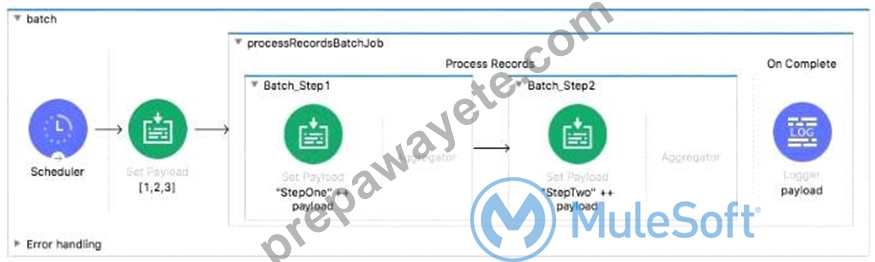
What is the output payload in the On Complete phase
- A. summary statistics with NO record data
- B. The records processed by all batch steps: [StepTwostepOnel, stepTwostepOne2, StepTwoStepOne3]
- C. The original payload: [1,2,31
- D. The records processed by the last batch step: [StepTwol, StepTwo2, StepTwo3]
Answer: C
NEW QUESTION 40
Refer to the exhibits. The main flow contains an HTTP Request in the middle of the flow. The HTTP Listeners and HTTP Request use default configurations.
A web client submits a request to the main flow's HTTP Listener that includes query parameters for the pedigree of the piano.
What values are accessible to the Logger component at the end of the main flow?
- A. payload
pedigree query params producer var - B. payload
producer var - C. payload
pedigree query params - D. payload
Answer: A
NEW QUESTION 41
Refer to the exhibits. The Set Payload transformer in the addltem child flow uses DataWeave to create an order object.
What is the correct DataWeave code for the Set Payload transformer in the createOrder flow to use the addltem child flow to add a router call with the price of 100 to the order?
- A. addltem( { payload: { price: "100", item: "router", itemType: "cable" > } )
- B. addltem( { price: "100", item: "router", itemType: "cable" } )
- C. lookup( "addltem", { payload: { price: "100", item: "router", itemType: "cable" } > )
- D. lookup( "addltern", { price: "100", item: "router", itemType: "cable" } )
Answer: C
NEW QUESTION 42
Refer to the exhibits.

A
web client submits a request to http://localhQst:8081. What is the structure of the payload at the end of the flow?
A)
B)
C)
D)
- A. Option D
- B. Option B
- C. Option A
- D. Option C
Answer: C
NEW QUESTION 43
What valid RAML retrieves details on a specific by its orderld as a URL parameter?
A)
B)
C)
D)
- A. Option D
- B. Option B
- C. Option A
- D. Option C
Answer: C
NEW QUESTION 44
......
MuleSoft MCD-Level-1 Exam Syllabus Topics:
| Topic | Details |
|---|---|
| Topic 1 |
|
| Topic 2 |
|
| Topic 3 |
|
| Topic 4 |
|
| Topic 5 |
|
| Topic 6 |
|
| Topic 7 |
|
| Topic 8 |
|
| Topic 9 |
|
| Topic 10 |
|
| Topic 11 |
|
MuleSoft MCD-Level-1 Dumps PDF Are going to be The Best Score: https://www.prepawayete.com/MuleSoft/MCD-Level-1-practice-exam-dumps.html