

Achieve The Utmost Performance In PCNSA Exam Pass Guaranteed
Achive your Success with Latest Palo Alto Networks PCNSA Exam
Palo Alto Networks PCNSA (Palo Alto Networks Certified Network Security Administrator) Exam is a certification exam that tests an individual's knowledge and skills in network security administration using Palo Alto Networks technology. PCNSA exam is designed to validate the candidate's ability to configure, manage, and maintain Palo Alto Networks next-generation firewalls and related products. The PCNSA certification is intended for individuals who are responsible for the day-to-day operations of Palo Alto Networks-based security infrastructure, including security operations center (SOC) personnel, network security administrators, and network security engineers.
Palo Alto Networks is a well-known cybersecurity company that offers a range of security solutions and services for businesses and organizations. The Palo Alto Networks Certified Network Security Administrator (PCNSA) exam is designed to help IT professionals validate their skills and knowledge in network security administration. Palo Alto Networks Certified Network Security Administrator certification exam is recognized globally and is a great way for individuals to demonstrate their expertise in this area.
NEW QUESTION # 123
Which license is required to use the Palo Alto Networks built-in IP address EDLs?
- A. SD-Wan
- B. DNS Security
- C. WildFire
- D. Threat Prevention
Answer: D
Explanation:
Reference:
https://docs.paloaltonetworks.com/pan-os/9-0/pan-os-admin/policy/use-an-external-dynamic-list-in- policy/builtin-edls.html#:~:text=With%20an%
NEW QUESTION # 124
Which interface does not require a MAC or IP address?
- A. Virtual Wire
- B. Layer3
- C. Layer2
- D. Loopback
Answer: A
NEW QUESTION # 125
URL categories can be used as match criteria on which two policy types? (Choose two.)
- A. application override
- B. authentication
- C. decryption
- D. NAT
Answer: B,C
Explanation:
https://docs.paloaltonetworks.com/pan-os/8-1/pan-os-admin/url-filtering/url-filtering-concepts/url-category-as-policy-match-criteria.html
NEW QUESTION # 126
Your company occupies one floor in a single building. You have two Active Directory domain controllers on a single network. The firewall's management plane is only slightly utilized.
Which User-ID agent is sufficient in your network?
- A. Windows-based agent deployed on each domain controller
- B. PAN-OS integrated agent deployed on the firewall
- C. Citrix terminal server agent deployed on the network
- D. Windows-based agent deployed on the internal network a domain member
Answer: B
Explanation:
Which User-ID agent should I use?
Use agentless (PAN-OS)
If you have a small to medium deployment with 10 or fewer Domain controllers or Exchange servers If you wish to share PAN-OS sourced mappings from AD, Captive portal or Global Protect with other PA devices (max 255 devices) Use User-ID Agent (Windows) If you have medium to large deployment with more than 10 domain controllers If you have multi-domain setup with large number of servers to monitor
NEW QUESTION # 127
Based on the show security policy rule would match all FTP traffic from the inside zone to the outside zone?
- A. internal-inside-dmz
- B. engress outside
- C. inside-portal
- D. intercone-default
Answer: B
NEW QUESTION # 128
Which two App-ID applications will need to be allowed to use facebook-chat? (Choose two.)
- A. facebook-base
- B. facebook
- C. facebook-email
- D. facebook-chat
Answer: A,D
Explanation:
Explanation/Reference: https://knowledgebase.paloaltonetworks.com/KCSArticleDetail?id=kA10g000000ClV0CAK
NEW QUESTION # 129
When creating a Source NAT policy, which entry in the Translated Packet tab will display the options Dynamic IP and Port, Dynamic, Static IP, and None?
- A. IP Address
- B. Interface
- C. Address Type
- D. Translation Type
Answer: D
NEW QUESTION # 130
Which feature would be useful for preventing traffic from hosting providers that place few restrictions on content, whose services are frequently used by attackers to distribute illegal or unethical material?
- A. Palo Alto Networks High-Risk IP Addresses
- B. Palo Alto Networks Bulletproof IP Addresses
- C. Palo Alto Networks Known Malicious IP Addresses
- D. Palo Alto Networks C&C IP Addresses
Answer: B
Explanation:
To block hosts that use bulletproof hosts to provide malicious, illegal, and/or unethical content, use the bulletproof IP address list in policy.
https://knowledgebase.paloaltonetworks.com/KCSArticleDetail?id=kA10g000000PM0pCAG
NEW QUESTION # 131
An address object of type IP Wildcard Mask can be referenced in which part of the configuration?
- A. external dynamic list
- B. NAT address pool
- C. Security policy rule
- D. ACC global filter
Answer: C
Explanation:
You can use an address object of type IP Wildcard Mask only in a Security policy rule.
https://docs.paloaltonetworks.com/pan-os/9-0/pan-os-web-interface-help/objects/objects-addresses IP Wildcard Mask
-Enter an IP wildcard address in the format of an IPv4 address followed by a slash and a mask (which must begin with a zero); for example, 10.182.1.1/0.127.248.0. In the wildcard mask, a zero (0) bit indicates that the bit being compared must match the bit in the IP address that is covered by the 0. A one (1) bit in the mask is a wildcard bit, meaning the bit being compared need not match the bit in the IP address that is covered by the 1. Convert the IP address and the wildcard mask to binary. To illustrate the matching: on binary snippet 0011, a wildcard mask of 1010 results in four matches (0001, 0011, 1001, and 1011).
NEW QUESTION # 132
What is the main function of the Test Policy Match function?
- A. ensure that policy rules are not shadowing other policy rules
- B. verify that policy rules from Expedition are valid
- C. confirm that policy rules in the configuration are allowing/denying the correct traffic
- D. confirm that rules meet or exceed the Best Practice Assessment recommendations
Answer: A
NEW QUESTION # 133
When creating a Source NAT policy, which entry in the Translated Packet tab will display the options Dynamic IP and Port, Dynamic, Static IP, and None?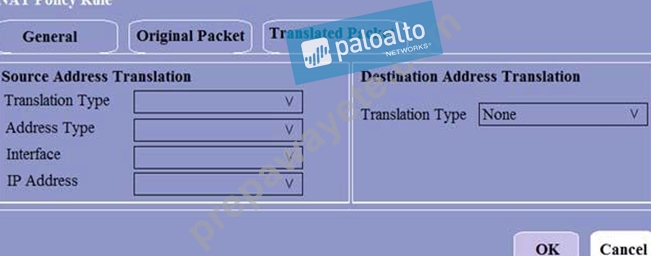
- A. IP Address
- B. Interface
- C. Address Type
- D. Translation Type
Answer: D
NEW QUESTION # 134
Selecting the option to revert firewall changes will replace what settings?
- A. dynamic update scheduler settings
- B. the device state with settings from another configuration
- C. the candidate configuration with settings from the running configuration
- D. the running configuration with settings from the candidate configuration
Answer: B
Explanation:
https://docs.paloaltonetworks.com/pan-os/8-1/pan-os-admin/firewall-administration/manage-configuration-backups/revert-firewall-configuration-changes.html
NEW QUESTION # 135
Which statement is true regarding a Best Practice Assessment?
- A. It runs only on firewalls.
- B. It shows how current configuration compares to Palo Alto Networks recommendations.
- C. When guided by an authorized sales engineer, it helps determine the areas of greatest risk where you should focus prevention activities.
- D. It provides a set of questionnaires that help uncover security risk prevention gaps across all areas of network and security architecture.
Answer: B
NEW QUESTION # 136
What are three ways application characteristics are used? (Choose three.)
- A. As a setting to define a new custom application
- B. As an Object to define Security policies
- C. As a global filter in the Application Command Center (ACC)
- D. As an attribute to define an application filter
- E. As an attribute to define an application group
Answer: A,D,E
NEW QUESTION # 137
What are two differences between an implicit dependency and an explicit dependency in App-ID? (Choose two.)
- A. An implicit dependency requires the dependent application to be added in the security policy
- B. An explicit dependency requires the dependent application to be added in the security policy
- C. An implicit dependency does not require the dependent application to be added in the security policy
- D. An explicit dependency does not require the dependent application to be added in the security policy
Answer: B,C
Explanation:
Explanation
NEW QUESTION # 138
Based on the screenshot presented which column contains the link that when clicked opens a window to display all applications matched to the policy rule?
- A. Service
- B. Apps Allowed
- C. Apps Seen
- D. Name
Answer: D
NEW QUESTION # 139
Given the Cyber-Attack Lifecycle diagram, identify the stage in which the attacker can initiate malicious code against a targeted machine.
- A. Reconnaissance
- B. Installation
- C. Exploitation
- D. Act on Objective
Answer: C
NEW QUESTION # 140
......
Achieving the PCNSA certification is a significant accomplishment in the field of network security. It demonstrates to employers and colleagues that the certified individual possesses the knowledge and skills necessary to manage and secure network infrastructures using Palo Alto Networks technologies. Additionally, certification holders may be eligible for higher salaries and career advancement opportunities due to their demonstrated expertise in network security administration.
Revolutionary Guide To Exam Palo Alto Networks Dumps: https://www.prepawayete.com/Palo-Alto-Networks/PCNSA-practice-exam-dumps.html
The PCNSA Exam Test For Brief Preparation: https://drive.google.com/open?id=1M-K76swoppYgSMLqJK8r8VjQs0ygF0mX