

Get Databricks-Certified-Professional-Data-Engineer Braindumps & Databricks-Certified-Professional-Data-Engineer Real Exam Questions
Databricks Databricks-Certified-Professional-Data-Engineer Actual Questions and Braindumps
NEW QUESTION # 84
Data engineering team has a job currently setup to run a task load data into a reporting table every day at 8: 00 AM takes about 20 mins, Operations teams are planning to use that data to run a second job, so they access latest complete set of data. What is the best to way to orchestrate this job setup?
- A. Use Auto Loader to run every 20 mins to read the initial table and set the trigger to once and create a second job
- B. Add Operation reporting task in the same job and set the operations reporting task to depend on Data Engineering task
- C. Setup a second job to run at 8:20 AM in the same workspace
- D. Add Operation reporting task in the same job and set the Data Engineering task to de-pend on Operations reporting task
- E. Setup a Delta live to table based on the first table, set the job to run in continuous mode
Answer: B
Explanation:
Explanation
The answer is Add Operation reporting task in the same job and set the operations reporting task to depend on Data Engineering task.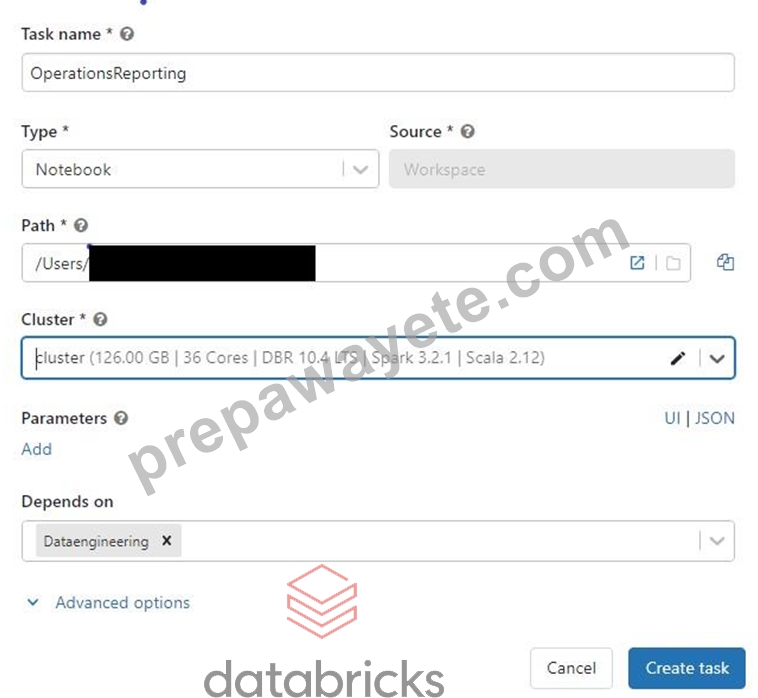
Diagram Description automatically generated with medium confidence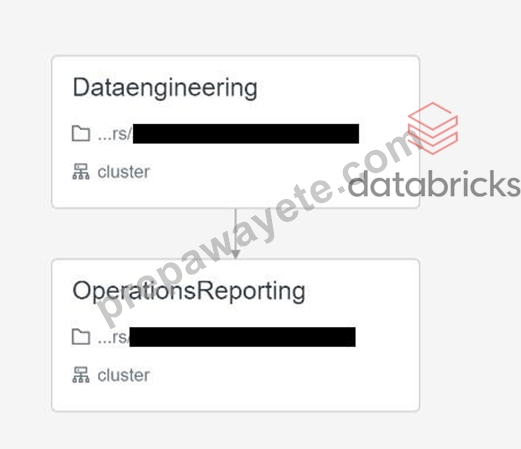
NEW QUESTION # 85
Question-3: In machine learning, feature hashing, also known as the hashing trick (by analogy to the kernel
trick), is a fast and space-efficient way of vectorizing features (such as the words in a language), i.e., turning
arbitrary features into indices in a vector or matrix. It works by applying a hash function to the features and
using their hash values modulo the number of features as indices directly, rather than looking the indices up in
an associative array. So what is the primary reason of the hashing trick for building classifiers?
- A. It creates the smaller models
- B. It requires the lesser memory to store the coefficients for the model
- C. It reduces the non-significant features e.g. punctuations
- D. Noisy features are removed
Answer: B
Explanation:
Explanation
This hashed feature approach has the distinct advantage of requiring less memory and one less pass through
the training data, but it can make it much harder to reverse engineer vectors to determine which original
feature mapped to a vector location. This is because multiple features may hash to the same location. With
large vectors or with multiple locations per feature, this isn't a problem for accuracy but it can make it hard to
understand what a classifier is doing.
Models always have a coefficient per feature, which are stored in memory during model building. The hashing
trick collapses a high number of features to a small number which reduces the number of coefficients and thus
memory requirements. Noisy features are not removed; they are combined with other features and so still have
an impact.
The validity of this approach depends a lot on the nature of the features and problem domain; knowledge of
the domain is important to understand whether it is applicable or will likely produce poor results. While
hashing features may produce a smaller model, it will be one built from odd combinations of real-world
features, and so will be harder to interpret.
An additional benefit of feature hashing is that the unknown and unbounded vocabularies typical of word-like
variables aren't a problem.
NEW QUESTION # 86
What is the type of table created when you issue SQL DDL command CREATE TABLE sales (id int, units int)
- A. External Table
- B. Query fails due to missing format
- C. Managed Delta table
- D. Query fails due to missing location
- E. Managed Parquet table
Answer: C
Explanation:
Explanation
Answer is Managed Delta table
Anytime a table is created without the Location keyword it is considered a managed table, by de-fault all managed tables DELTA tables Syntax CREATE TABLE table_name ( column column_data_type...)
NEW QUESTION # 87
A data engineer has configured a Structured Streaming job to read from a table, manipulate the data, and then
perform a streaming write into a new table. The code block used by the data engineer is below:
1. (spark.table("sales")
2. .withColumn("avg_price", col("sales") / col("units"))
3. .writeStream
4. .option("checkpointLocation", checkpointPath)
5. .outputMode("complete")
6. ._____
7. .table("new_sales")
8.)
If the data engineer only wants the query to execute a single micro-batch to process all of the available data,
which of the following lines of code should the data engineer use to fill in the blank?
- A. .trigger(processingTime="once")
- B. .trigger(once=True)
- C. .trigger(continuous="once")
- D. .processingTime("once")
- E. .processingTime(1)
Answer: B
NEW QUESTION # 88
A DLT pipeline includes the following streaming tables:
Raw_lot ingest raw device measurement data from a heart rate tracking device.
Bgm_stats incrementally computes user statistics based on BPM measurements from raw_lot.
How can the data engineer configure this pipeline to be able to retain manually deleted or updated records in the raw_iot table while recomputing the downstream table when a pipeline update is run?
- A. Set the SkipChangeCommits flag to true raw_lot
- B. Set the pipelines, reset, allowed property to false on bpm_stats
- C. Set the pipelines, reset, allowed property to false on raw_iot
- D. Set the skipChangeCommits flag to true on bpm_stats
Answer: C
NEW QUESTION # 89
You are currently working on reloading customer_sales tables using the below query
1. INSERT OVERWRITE customer_sales
2. SELECT * FROM customers c
3. INNER JOIN sales_monthly s on s.customer_id = c.customer_id
After you ran the above command, the Marketing team quickly wanted to review the old data that was in the table. How does INSERT OVERWRITE impact the data in the customer_sales table if you want to see the previous version of the data prior to running the above statement?
- A. Appends the data to the current version, you can time travel to previous versions
- B. Overwrites the current version of the data but clears all historical versions of the data, so you can not time travel to previous versions.
- C. By default, overwrites the data and schema, you cannot perform time travel
- D. Overwrites the data in the table but preserves all historical versions of the data, you can time travel to previous versions
- E. Overwrites the data in the table, all historical versions of the data, you can not time travel to previous versions
Answer: D
Explanation:
Explanation
The answer is, INSERT OVERWRITE Overwrites the current version of the data but preserves all historical versions of the data, you can time travel to previous versions.
1.INSERT OVERWRITE customer_sales
2.SELECT * FROM customers c
3.INNER JOIN sales s on s.customer_id = c.customer_id
Let's just assume that this is the second time you are running the above statement, you can still query the prior version of the data using time travel, and any DML/DDL except DROP TABLE creates new PARQUET files so you can still access the previous versions of data.
SQL Syntax for Time travel
SELECT * FROM table_name as of [version number]
with customer_sales example
SELECT * FROM customer_sales as of 1 -- previous version
SELECT * FROM customer_sales as of 2 -- current version
You see all historical changes on the table using DESCRIBE HISTORY table_name Note: the main difference between INSERT OVERWRITE and CREATE OR REPLACE TABLE(CRAS) is that CRAS can modify the schema of the table, i.e it can add new columns or change data types of existing columns. By default INSERT OVERWRITE only overwrites the data.
INSERT OVERWRITE can also be used to update the schema when
spark.databricks.delta.schema.autoMerge.enabled is set true if this option is not enabled and if there is a schema mismatch command INSERT OVERWRITEwill fail.
Any DML/DDL operation(except DROP TABLE) on the Delta table preserves the historical ver-sion of the data.
NEW QUESTION # 90
A Delta Lake table was created with the below query:
Realizing that the original query had a typographical error, the below code was executed:
ALTER TABLE prod.sales_by_stor RENAME TO prod.sales_by_store
Which result will occur after running the second command?
- A. The table name change is recorded in the Delta transaction log.
- B. A new Delta transaction log Is created for the renamed table.
- C. All related files and metadata are dropped and recreated in a single ACID transaction.
- D. The table reference in the metastore is updated and no data is changed.
- E. The table reference in the metastore is updated and all data files are moved.
Answer: D
Explanation:
The query uses the CREATE TABLE USING DELTA syntax to create a Delta Lake table from an existing Parquet file stored in DBFS. The query also uses the LOCATION keyword to specify the path to the Parquet file as /mnt/finance_eda_bucket/tx_sales.parquet. By using the LOCATION keyword, the query creates an external table, which is a table that is stored outside of the default warehouse directory and whose metadata is not managed by Databricks. An external table can be created from an existing directory in a cloud storage system, such as DBFS or S3, that contains data files in a supported format, such as Parquet or CSV.
The result that will occur after running the second command is that the table reference in the metastore is updated and no data is changed. The metastore is a service that stores metadata about tables, such as their schema, location, properties, and partitions. The metastore allows users to access tables using SQL commands or Spark APIs without knowing their physical location or format. When renaming an external table using the ALTER TABLE RENAME TO command, only the table reference in the metastore is updated with the new name; no data files or directories are moved or changed in the storage system. The table will still point to the same location and use the same format as before. However, if renaming a managed table, which is a table whose metadata and data are both managed by Databricks, both the table reference in the metastore and the data files in the default warehouse directory are moved and renamed accordingly. Verified References:
[Databricks Certified Data Engineer Professional], under "Delta Lake" section; Databricks Documentation, under "ALTER TABLE RENAME TO" section; Databricks Documentation, under "Metastore" section; Databricks Documentation, under "Managed and external tables" section.
NEW QUESTION # 91
The data engineering team maintains the following code: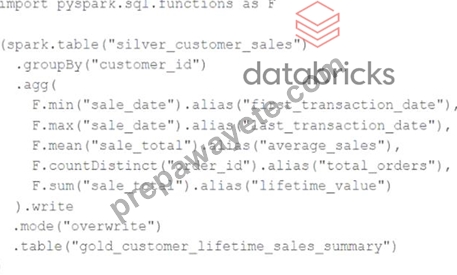
Assuming that this code produces logically correct results and the data in the source table has been de-duplicated and validated, which statement describes what will occur when this code is executed?
- A. An incremental job will detect if new rows have been written to the silver_customer_sales table; if new rows are detected, all aggregates will be recalculated and used to overwrite the gold_customer_lifetime_sales_summary table.
- B. The silver_customer_sales table will be overwritten by aggregated values calculated from all records in the gold_customer_lifetime_sales_summary table as a batch job.
- C. A batch job will update the gold_customer_lifetime_sales_summary table, replacing only those rows that have different values than the current version of the table, using customer_id as the primary key.
- D. An incremental job will leverage running information in the state store to update aggregate values in the gold_customer_lifetime_sales_summary table.
- E. The gold_customer_lifetime_sales_summary table will be overwritten by aggregated values calculated from all records in the silver_customer_sales table as a batch job.
Answer: E
Explanation:
This code is using the pyspark.sql.functions library to group the silver_customer_sales table by customer_id and then aggregate the data using the minimum sale date, maximum sale total, and sum of distinct order ids.
The resulting aggregated data is then written to the gold_customer_lifetime_sales_summary table, overwriting any existing data in that table. This is a batch job that does not use any incremental or streaming logic, and does not perform any merge or update operations. Therefore, the code will overwrite the gold table with the aggregated values from the silver table every time it is executed. References:
* https://docs.databricks.com/spark/latest/dataframes-datasets/introduction-to-dataframes-python.html
* https://docs.databricks.com/spark/latest/dataframes-datasets/transforming-data-with-dataframes.html
* https://docs.databricks.com/spark/latest/dataframes-datasets/aggregating-data-with-dataframes.html
NEW QUESTION # 92
The Databricks CLI is used to trigger a run of an existing job by passing the job_id parameter. The response indicating the job run request was submitted successfully includes a field run_id. Which statement describes what the number alongside this field represents?
- A. The job_id and number of times the job has been run are concatenated and returned.
- B. The job_id is returned in this field.
- C. The globally unique ID of the newly triggered run.
- D. The number of times the job definition has been run in this workspace.
Answer: C
Explanation:
Comprehensive and Detailed Explanation From Exact Extract:
Exact extract: "run_id: The canonical identifier of a run."
Exact extract: "Each job run has a unique run_id."
When a run is created via the Jobs API/CLI, Databricks returns a unique run_id for that specific run instance, distinct from the job's job_id.
Reference:
NEW QUESTION # 93
Each configuration below is identical to the extent that each cluster has 400 GB total of RAM, 160 total cores and only one Executor per VM.
Given a job with at least one wide transformation, which of the following cluster configurations will result in maximum performance?
- A. * Total VMs; 1
* 400 GB per Executor
* 160 Cores / Executor - B. * Total VMs: 8
* 50 GB per Executor
* 20 Cores / Executor
Answer: B
Explanation:
C.
* Total VMs: 4
* 100 GB per Executor
* 40 Cores/Executor
D.
* Total VMs:2
* 200 GB per Executor
* 80 Cores / Executor
Explanation:
This is the correct answer because it is the cluster configuration that will result in maximum performance for a job with at least one wide transformation. A wide transformation is a type of transformation that requires shuffling data across partitions, such as join, groupBy, or orderBy. Shuffling can be expensive and time-consuming, especially if there are too many or too few partitions. Therefore, it is important to choose a cluster configuration that can balance the trade-off between parallelism and network overhead. In this case, having 8 VMs with 50 GB per executor and 20 cores per executor will create 8 partitions, each with enough memory and CPU resources to handle the shuffling efficiently. Having fewer VMs with more memory and cores per executor will create fewer partitions, which will reduce parallelism and increase the size of each shuffle block. Having more VMs with less memory and cores per executor will create more partitions, which will increase parallelism but also increase the network overhead and the number of shuffle files. Verified Reference: [Databricks Certified Data Engineer Professional], under "Performance Tuning" section; Databricks Documentation, under "Cluster configurations" section.
NEW QUESTION # 94
A junior data engineer on your team has implemented the following code block.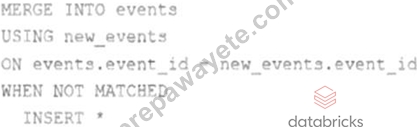
The viewnew_eventscontains a batch of records with the same schema as theeventsDelta table.
Theevent_idfield serves as a unique key for this table.
When this query is executed, what will happen with new records that have the sameevent_idas an existing record?
- A. They are ignored.
- B. They are deleted.
- C. They are merged.
- D. They are updated.
- E. They are inserted.
Answer: A
Explanation:
This is the correct answer because it describes what will happen with new records that have the same event_id as an existing record when the query is executed. The query uses the INSERT INTO command to append new records from the view new_events to the table events. However, the INSERT INTO command does not check for duplicate values in the primary key column (event_id) and does not perform any update or delete operations on existing records. Therefore, if there are new records that have the same event_id as an existing record, they will be ignored and not inserted into the table events. Verified References: [Databricks Certified Data Engineer Professional], under "Delta Lake" section; Databricks Documentation, under "Append data using INSERT INTO" section.
"If none of the WHEN MATCHED conditions evaluate to true for a source and target row pair that matches the merge_condition, then the target row is left unchanged."https://docs.databricks.com/en/sql/language- manual/delta-merge-into.html#:~:text=If%20none%20of%20the%20WHEN%20MATCHED%20conditions%
20evaluate%20to%20true%20for%20a%20source%20and%20target%20row%20pair%20that%20matches%
20the%20merge_condition%2C%20then%20the%20target%20row%20is%20left%20unchanged.
NEW QUESTION # 95
Which statement regarding stream-static joins and static Delta tables is correct?
- A. The checkpoint directory will be used to track state information for the unique keys present in the join.
- B. Each microbatch of a stream-static join will use the most recent version of the static Delta table as of each microbatch.
- C. The checkpoint directory will be used to track updates to the static Delta table.
- D. Each microbatch of a stream-static join will use the most recent version of the static Delta table as of the job's initialization.
- E. Stream-static joins cannot use static Delta tables because of consistency issues.
Answer: B
Explanation:
This is the correct answer because stream-static joins are supported by Structured Streaming when one of the tables is a static Delta table. A static Delta table is a Delta table that is not updated by any concurrent writes, such as appends or merges, during the execution of a streaming query. In this case, each microbatch of a stream-static join will use the most recent version of the static Delta table as of each microbatch, which means it will reflect any changes made to the static Delta table before the start of each microbatch. Verified References: [Databricks Certified Data Engineer Professional], under "Structured Streaming" section; Databricks Documentation, under "Stream and static joins" section.
NEW QUESTION # 96
A data engineer is using Lakeflow Declarative Pipelines Expectations feature to track the data quality of their incoming sensor data. Periodically, sensors send bad readings that are out of range, and they are currently flagging those rows with a warning and writing them to the silver table along with the good data. They've been given a new requirement - the bad rows need to be quarantined in a separate quarantine table and no longer included in the silver table.
This is the existing code for their silver table:
@dlt.table
@dlt.expect("valid_sensor_reading", "reading < 120")
def silver_sensor_readings():
return spark.readStream.table("bronze_sensor_readings")
What code will satisfy the requirements?
- A. @dlt.table
@dlt.expect_or_drop("valid_sensor_reading", "reading < 120")
def silver_sensor_readings():
return spark.readStream.table("bronze_sensor_readings")
@dlt.table
@dlt.expect_or_drop("invalid_sensor_reading", "reading >= 120")
def quarantine_sensor_readings():
return spark.readStream.table("bronze_sensor_readings") - B. @dlt.table
@dlt.expect_or_drop("valid_sensor_reading", "reading < 120")
def silver_sensor_readings():
return spark.readStream.table("bronze_sensor_readings")
@dlt.table
@dlt.expect("invalid_sensor_reading", "reading >= 120")
def quarantine_sensor_readings():
return spark.readStream.table("bronze_sensor_readings") - C. @dlt.table
@dlt.expect("valid_sensor_reading", "reading < 120")
def silver_sensor_readings():
return spark.readStream.table("bronze_sensor_readings")
@dlt.table
@dlt.expect("invalid_sensor_reading", "reading >= 120")
def quarantine_sensor_readings():
return spark.readStream.table("bronze_sensor_readings") - D. @dlt.table
@dlt.expect_or_drop("valid_sensor_reading", "reading < 120")
def silver_sensor_readings():
return spark.readStream.table("bronze_sensor_readings")
@dlt.table
@dlt.expect("invalid_sensor_reading", "reading < 120")
def quarantine_sensor_readings():
return spark.readStream.table("bronze_sensor_readings")
Answer: C
Explanation:
Comprehensive and Detailed Explanation from Databricks Documentation:
Lakeflow Declarative Pipelines (DLT) supports data quality enforcement using @dlt.expect, @dlt.expect_or_drop, and @dlt.expect_all.
@dlt.expect applies a rule and records whether rows pass or fail the condition but does not drop failing rows. Instead, failing rows can be written to a quarantine table.
@dlt.expect_or_drop enforces that only rows passing the condition flow downstream, dropping bad records automatically.
In this case, the requirement is:
Good rows (reading < 120) go to the silver table.
Bad rows (reading >= 120) go to a quarantine table.
Bad rows should not be included in silver.
The correct implementation is Option A, where:
The silver table uses @dlt.expect to validate reading < 120. These rows flow normally.
The quarantine table applies an expectation for reading >= 120, ensuring bad records are captured separately.
Other options are incorrect:
Option B/D: These either use expect_or_drop incorrectly or apply wrong conditions, leading to dropped rows without quarantining properly.
Option C: Uses expect_or_drop for both tables, which would discard bad rows instead of persisting them into a quarantine table.
Thus, Option A meets the business requirement to split good and bad data streams while ensuring both are captured for auditing and processing.
NEW QUESTION # 97
A Structured Streaming job deployed to production has been experiencing delays during peak hours of the day.
At present, during normal execution, each microbatch of data is processed in less than 3 seconds. During peak hours of the day, execution time for each microbatch becomes very inconsistent, sometimes exceeding 30 seconds. The streaming write is currently configured with a trigger interval of 10 seconds.
Holding all other variables constant and assuming records need to be processed in less than 10 seconds, which adjustment will meet the requirement?
- A. Use the trigger once option and configure a Databricks job to execute the query every 10 seconds; this ensures all backlogged records are processed with each batch.
- B. Decrease the trigger interval to 5 seconds; triggering batches more frequently allows idle executors to begin processing the next batch while longer running tasks from previous batches finish.
- C. The trigger interval cannot be modified without modifying the checkpoint directory; to maintain the current stream state, increase the number of shuffle partitions to maximize parallelism.
- D. Decrease the trigger interval to 5 seconds; triggering batches more frequently may prevent records from backing up and large batches from causing spill.
- E. Increase the trigger interval to 30 seconds; setting the trigger interval near the maximum execution time observed for each batch is always best practice to ensure no records are dropped.
Answer: D
Explanation:
Explanation
The adjustment that will meet the requirement of processing records in less than 10 seconds is to decrease the trigger interval to 5 seconds. This is because triggering batches more frequently may prevent records from backing up and large batches from causing spill. Spill is a phenomenon where the data in memory exceeds the available capacity and has to be written to disk, which can slow down the processing and increase the execution time1. By reducing the trigger interval, the streaming query can process smaller batches of data more quickly and avoid spill. This can also improve the latency and throughput of the streaming job2.
The other options are not correct, because:
Option A is incorrect because triggering batches more frequently does not allow idle executors to begin processing the next batch while longer running tasks from previous batches finish. In fact, the opposite is true. Triggering batches more frequently may cause concurrent batches to compete for the same resources and cause contention and backpressure2. This can degrade the performance and stability of the streaming job.
Option B is incorrect because increasing the trigger interval to 30 seconds is not a good practice to ensure no records are dropped. Increasing the trigger interval means that the streaming query will process larger batches of data less frequently, which can increase the risk of spill, memory pressure, and timeouts12. This can also increase the latency and reduce the throughput of the streaming job.
Option C is incorrect because the trigger interval can be modified without modifying the checkpoint directory. The checkpoint directory stores the metadata and state of the streaming query, such as the offsets, schema, and configuration3. Changing the trigger interval does not affect the state of the streaming query, and does not require a new checkpoint directory. However, changing the number of shuffle partitions may affect the state of the streaming query, and may require a new checkpoint directory4.
Option D is incorrect because using the trigger once option and configuring a Databricks job to execute the query every 10 seconds does not ensure that all backlogged records are processed with each batch. The trigger once option means that the streaming query will process all the available data in the source and then stop5. However, this does not guarantee that the query will finish processing within 10 seconds, especially if there area lot of records in the source. Moreover, configuring a Databricks job to execute the query every 10 seconds may cause overlapping or missed batches, depending on the execution time of the query.
References: Memory Management Overview, Structured Streaming Performance Tuning Guide, Checkpointing, Recovery Semantics after Changes in a Streaming Query, Triggers
NEW QUESTION # 98
You are working on a dashboard that takes a long time to load in the browser, due to the fact that each visualization contains a lot of data to populate, which of the following approaches can be taken to address this issue?
- A. Remove data from Delta Lake
- B. Increase size of the SQL endpoint cluster
- C. Use Databricks SQL Query filter to limit the amount of data in each visualization
- D. Increase the scale of maximum range of SQL endpoint cluster
- E. Use Delta cache to store the intermediate results
Answer: C
Explanation:
Explanation
Note*: The question may sound misleading but these are types of questions the exam tries to ask.
A query filter lets you interactively reduce the amount of data shown in a visualization, similar to query parameter but with a few key differences. A query filter limits data after it has been loaded into your browser.
This makes filters ideal for smaller datasets and environments where query executions are time-consuming, rate-limited, or costly.
This query filter is different from than filter that needs to be applied at the data level, this filter is at the visualization level so you can toggle how much data you want to see.
1.SELECT action AS `action::filter`, COUNT(0) AS "actions count"
2.FROM events
3.GROUP BY action
When queries have filters you can also apply filters at the dashboard level. Select the Use Dash-board Level Filters checkbox to apply the filter to all queries.
Dashboard filters
Query filters | Databricks on AWS
NEW QUESTION # 99
A Databricks SQL dashboard has been configured to monitor the total number of records present in a collection of Delta Lake tables using the following query pattern:
SELECT COUNT (*) FROM table -
Which of the following describes how results are generated each time the dashboard is updated?
- A. The total count of records is calculated from the Hive metastore
- B. The total count of records is calculated from the parquet file metadata
- C. The total count of records is calculated from the Delta transaction logs
- D. The total count of rows will be returned from cached results unless REFRESH is run
- E. The total count of rows is calculated by scanning all data files
Answer: C
Explanation:
Explanation
https://delta.io/blog/2023-04-19-faster-aggregations-metadata/#:~:text=You%20can%20get%20the%20number,a
NEW QUESTION # 100
A data engineer is creating a data ingestion pipeline to understand where customers are taking their rented bicycles during use. The engineer noticed that, over time, data being transmitted from the bicycle sensors fail to include key details like latitude and longitude. Downstream analysts need both the clean records and the quarantined records available for separate processing.
The data engineer already has this code:
import dlt
from pyspark.sql.functions import expr
rules = {
"valid_lat": "(lat IS NOT NULL)",
"valid_long": "(long IS NOT NULL)"
}
quarantine_rules = "NOT({})".format(" AND ".join(rules.values()))
@dlt.view
def raw_trips_data():
return spark.readStream.table("ride_and_go.telemetry.trips")
How should the data engineer meet the requirements to capture good and bad data?
- A. @dlt.table(partition_cols=["is_quarantined", ])
@dlt.expect_all(rules)
def trips_data_quarantine():
return (
spark.readStream.table("raw_trips_data")
.withColumn("is_quarantined", expr(quarantine_rules))
) - B. @dlt.view
@dlt.expect_or_drop("lat_long_present", "(lat IS NOT NULL AND long IS NOT NULL)") def trips_data_quarantine():
return spark.readStream.table("ride_and_go.telemetry.trips") - C. @dlt.table
@dlt.expect_all_or_drop(rules)
def trips_data_quarantine():
return spark.readStream.table("raw_trips_data") - D. @dlt.table(name="trips_data_quarantine")
def trips_data_quarantine():
return (
spark.readStream.table("raw_trips_data")
.filter(expr(quarantine_rules))
)
Answer: D
Explanation:
The requirement is that both valid (good) and invalid (bad) records must be captured and available separately for downstream processing. Invalid records should not simply be dropped; they must be quarantined in a dedicated table.
In Databricks Lakeflow Declarative Pipelines (DLT), this is achieved by creating separate output tables:
One table for valid records (Silver table) that pass the expectations.
Another quarantine table that explicitly captures records failing the expectations.
Option A correctly implements this by:
Declaring a DLT table trips_data_quarantine.
Using .filter(expr(quarantine_rules)) to isolate invalid records (records where latitude or longitude is NULL).
This ensures analysts can query both good records (from the main Silver pipeline table) and bad records (from the quarantine table).
Why not the others?
B: Uses @dlt.expect_or_drop, which drops invalid records instead of quarantining them. This violates the requirement that quarantined data should be available.
C: Same as B, but applies expectations in bulk with expect_all_or_drop. Again, bad data is dropped, not quarantined.
D: Adds an is_quarantined flag in the same table. While it marks bad records, it does not separate them into a distinct quarantine table as required by the business use case.
Therefore, Option A is the only solution aligned with Databricks documentation for quarantining invalid data into a dedicated table while keeping valid data in the main pipeline.
NEW QUESTION # 101
Consider flipping a coin for which the probability of heads is p, where p is unknown, and our goa is to
estimate p. The obvious approach is to count how many times the coin came up heads and divide by the total
number of coin flips. If we flip the coin 1000 times and it comes up heads 367 times, it is very reasonable to
estimate p as approximately 0.367. However, suppose we flip the coin only twice and we get heads both times.
Is it reasonable to estimate p as 1.0? Intuitively, given that we only flipped the coin twice, it seems a bit
rash to conclude that the coin will always come up heads, and____________is a way of avoiding such rash
conclusions.
- A. Linear Regression
- B. Laplace Smoothing
- C. Logistic Regression
- D. Naive Bayes
Answer: B
Explanation:
Explanation
Smooth the estimates:consider flipping a coin for which the probability of heads is p, where p is unknown, and
our goal is to estimate p. The obvious approach is to count how many times the coin came up heads and divide
by the total number of coin flips. If we flip the coin 1000 times and it comes up heads 367 times, it is very
reasonable to estimate p as approximately 0.367. However, suppose we flip the coin only twice and we get
heads both times. Is it reasonable to estimate p as 1.0? Intuitively, given that we only flipped the coin twice, it
seems a bit rash to conclude that the coin will always come up heads, and smoothing is a way of avoiding such
rash conclusions. A simple smoothing method, called Laplace smoothing (or Laplace's law of succession or
add-one smoothing in R&N), is to estimate p by (one plus the number of heads) / (two plus the total number of
flips). Said differently, if we are keeping count of the number of heads and the number of tails, this rule is
equivalent to starting each of our counts at one, rather than zero. Another advantage of Laplace smoothing is
that it avoids estimating any probabilities to be zero, even for events never observed in the data. Laplace
add-one smoothing now assigns too much probability to unseen words
NEW QUESTION # 102
The view updates represents an incremental batch of all newly ingested data to be inserted or updated in the customers table.
The following logic is used to process these records.
MERGE INTO customers
USING (
SELECT updates.customer_id as merge_ey, updates .*
FROM updates
UNION ALL
SELECT NULL as merge_key, updates .*
FROM updates JOIN customers
ON updates.customer_id = customers.customer_id
WHERE customers.current = true AND updates.address <> customers.address ) staged_updates ON customers.customer_id = mergekey WHEN MATCHED AND customers. current = true AND customers.address <> staged_updates.address THEN UPDATE SET current = false, end_date = staged_updates.effective_date WHEN NOT MATCHED THEN INSERT (customer_id, address, current, effective_date, end_date) VALUES (staged_updates.customer_id, staged_updates.address, true, staged_updates.effective_date, null) Which statement describes this implementation?
- A. The customers table is implemented as a Type 2 table; old values are maintained but marked as no longer current and new values are inserted.
- B. The customers table is implemented as a Type 1 table; old values are overwritten by new values and no history is maintained.
- C. The customers table is implemented as a Type 0 table; all writes are append only with no changes to existing values.
- D. The customers table is implemented as a Type 2 table; old values are overwritten and new customers are appended.
Answer: A
Explanation:
The provided MERGE statement is a classic implementation of a Type 2 SCD in a data warehousing context.
In this approach, historical data is preserved by keeping old records (marking them as not current) and adding new records for changes. Specifically, when a match is found and there's a change in the address, the existing record in the customers table is updated to mark it as no longer current (current = false), and an end date is assigned (end_date = staged_updates.effective_date). A new record for the customer is then inserted with the updated information, marked as current. This method ensures that the full history of changes to customer information is maintained in the table, allowing for time-based analysis of customer data.References:
Databricks documentation on implementing SCDs using Delta Lake and the MERGE statement (https://docs.databricks.com/delta/delta-update.html#upsert-into-a-table-using-merge).
NEW QUESTION # 103
A member of the data engineering team has submitted a short notebook that they wish to schedule as part of a larger data pipeline. Assume that the commands provided below produce the logically correct results when run as presented.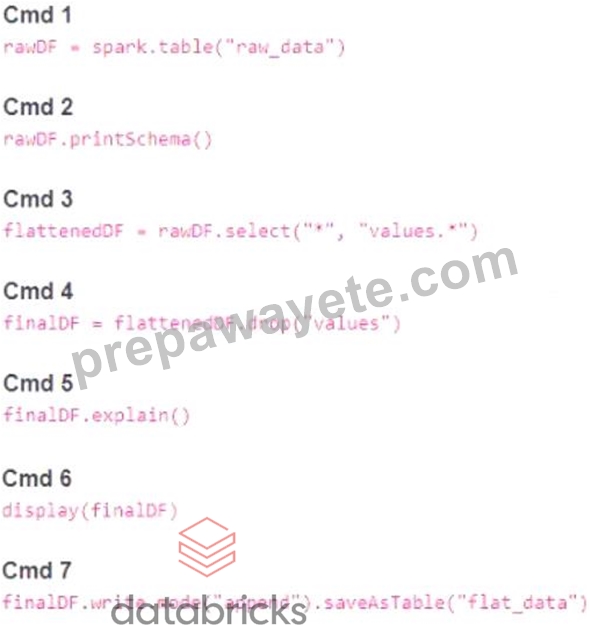
Which command should be removed from the notebook before scheduling it as a job?
- A. Cmd 2
- B. Cmd 5
- C. Cmd 3
- D. Cmd 6
- E. Cmd 4
Answer: D
Explanation:
Cmd 6 is the command that should be removed from the notebook before scheduling it as a job. This command is selecting all the columns from the finalDF dataframe and displaying them in the notebook. This is not necessary for the job, as the finalDF dataframe is already written to a table in Cmd 7. Displaying the dataframe in the notebook will only consume resources and time, and it will not affect the output of the job.
Therefore, Cmd 6 is redundant and should be removed.
The other commands are essential for the job, as they perform the following tasks:
* Cmd 1: Reads the raw_data table into a Spark dataframe called rawDF.
* Cmd 2: Prints the schema of the rawDF dataframe, which is useful for debugging and understanding the data structure.
* Cmd 3: Selects all the columns from the rawDF dataframe, as well as the nested columns from the values struct column, and creates a new dataframe called flattenedDF.
* Cmd 4: Drops the values column from the flattenedDF dataframe, as it is no longer needed after flattening, and creates a new dataframe called finalDF.
* Cmd 5: Explains the physical plan of the finalDF dataframe, which is useful for optimizing and tuning the performance of the job.
* Cmd 7: Writes the finalDF dataframe to a table called flat_data, using the append mode to add new data to the existing table.
NEW QUESTION # 104
Which statement regarding spark configuration on the Databricks platform is true?
- A. Spark configuration set within an notebook will affect all SparkSession attached to the same interactive cluster
- B. The Databricks REST API can be used to modify the Spark configuration properties for an interactive cluster without interrupting jobs.
- C. When the same spar configuration property is set for an interactive to the same interactive cluster.
- D. Spark configuration properties set for an interactive cluster with the Clusters UI will impact all notebooks attached to that cluster.
Answer: D
Explanation:
When Spark configuration properties are set for an interactive cluster using the Clusters UI in Databricks, those configurations are applied at the cluster level. This means that all notebooks attached to that cluster will inherit and be affected by these configurations. This approach ensures consistency across all executions within that cluster, as the Spark configuration properties dictate aspects such as memory allocation, number of executors, and other vital execution parameters. This centralized configuration management helps maintain standardized execution environments across different notebooks, aiding in debugging and performance optimization.
Reference:
Databricks documentation on configuring clusters: https://docs.databricks.com/clusters/configure.html
NEW QUESTION # 105
Which method is used to solve for coefficients bO, b1, ... bn in your linear regression model:
- A. Ridge and Lasso
- B. Apriori Algorithm
- C. Integer programming
- D. Ordinary Least squares
Answer: D
Explanation:
Explanation : RY = b0 + b1x1+b2x2+ .... +bnxn
In the linear model, the bi's represent the unknown p parameters. The estimates for these unknown parameters
are chosen so that, on average, the model provides a reasonable estimate of a person's income based on age
and education. In other words, the fitted model should minimize the overall error between the linear model and
the actual observations. Ordinary Least Squares (OLS) is a common technique to estimate the parameters
NEW QUESTION # 106
......
The DCPDE certification is an excellent way for data professionals to demonstrate their expertise in the Databricks platform. Databricks Certified Professional Data Engineer Exam certification is recognized globally and is highly valued by employers looking for data professionals with expertise in Databricks. The DCPDE certification provides professionals with the opportunity to enhance their career prospects and increase their earning potential.
Databricks-Certified-Professional-Data-Engineer Dumps To Pass Databricks Exam in 24 Hours - PrepAwayETE: https://www.prepawayete.com/Databricks/Databricks-Certified-Professional-Data-Engineer-practice-exam-dumps.html