

124 Exam Questions for L5M9 Updated Versions With Test Engine
Pass L5M9 Exam with Updated L5M9 Exam Dumps PDF 2026
NEW QUESTION # 68
Doug's Doughnuts Ltd is a large manufacturer of doughnuts. They produce in excess of 100,000 doughnuts per day which are boxed and sent to supermarkets and other retail outlets for sale. Large pieces of machinery are used to make the doughnuts. Which form of maintenance would be the most appropriate to use at Doug's Doughnuts?
- A. reactive
- B. run to breakdown
- C. preventative
- D. condition based
Answer: C
Explanation:
Preventative maintenance should be used at Doug's Doughnuts. The machines should be serviced regularly to ensure they're working well. A break-down in machinery would stop production, and because Doug's Doughnuts produce so many items per day, this would cause a serious issue for the company. Run to breakdown means you don't repair anything until the item is completely broken. Condition-based maintenance is when maintenance is scheduled when it is required, usually to a schedule. Reactive is when maintenance is conducted when something breaks. See p.103.
NEW QUESTION # 69
Khaled has recently been hired as an Operations Manager at a company providing consultancy services. This is his first role in the service industry, previously he has worked at companies providing goods. He understands that services are intangible and therefore there is a difference in how Operations may be managed. Which of the following sentences about services are true? Select THREE
- A. there is no variability in services
- B. services cannot be stored, unlike goods
- C. production and consumption occur simultaneously
- D. there is a transfer of ownership when purchasing a service
- E. it is not possible to return a service
Answer: B,C,E
Explanation:
The correct sentences are 2, 3 and 5. This is from the table comparing services and goods on p.47. Note that you can ask for a refund if you're unhappy with a service, but you can't physically return the service you've received. Option 1 is incorrect- there is no transfer of ownership with services (there is with goods). Option 4 is incorrect as every service is different- there is a high level of variability in delivery.
NEW QUESTION # 70
Bilal is an Operations Manager at an apple pie manufacturer and is currently undertaking an Aggregate Capacity Analysis.
What is the purpose of this?
- A. It will help Bilal decide if he needs to hire more workers in the short term to ensure the factory produces enough apple pies to meet demand
- B. It will help Bilal assess if he is working within the allocated budget
- C. It will give Bilal an overall evaluation of the company's ability to meet demand fluctuations
- D. It will tell Bilal if he has the correct number of apples he needs to produce the desired number of apple pies
Answer: C
Explanation:
Aggregate Capacity Analysis looks as medium-term capacity to see whether supply can match demand. This is from p.23. Aggregate means 'from a group or cluster' and therefore requires quite a few bits of data. For this reason option 1 is incorrect as this describes a very short term look at capacity analysis.
NEW QUESTION # 71
The Balanced Scorecard is a performance management approach which looks at measuring four areas of a business. Of those listed below, which is not an area traditionally measured within the Scorecard?
- A. business processes
- B. environment
- C. finance
- D. customer
Answer: B
Explanation:
Environment is not traditionally measured- the other missing criteria is learning and development. This is an approach developed by Kaplan and Norton and there's often at least one question in the exam on this. I recommend learning this as it does also come up in other modules at Level 5 too. For a rounded view of the Balanced Scorecard framework check out this YouTube video: https://www.youtube.com/watch?v=lGJ-25hikHA
NEW QUESTION # 72
Below are details of five companies who operate a Total Quality Management System (TQM). For each company, select the system used and identify which area of the Balanced Scorecard this relates to.
Company 1: The focus of this company is to gather real-time data to assess the quality of products created during the manufacturing process. There are tight budgets and reworking any defects will affect the bottom line.
Company 2: This company is concerned about how their products are received. They have recently completed market research focused on their client's feelings. The objective is now to improve the product's look and performance to meet these expectations.
Company 3: The focus of this company is defining the customer requirements and translating this into a high-quality specification and effective operational process.
Company 4: Within this company there is a group of 6 employees who meet regularly with the objective of reducing issues that arise in the manufacturing of products.
Complete the table below by listing the TQM System used and the relevant Balanced Scorecard criteria for each company. Each response should only be used once: Quality Circle, Statistical Process Control, Kansei Engineering, Quality Function Deployment, Finance Criteria, Business Process Criteria, Learning and Growth Criteria, Customer Criteria.
Which of the following will you put into box 4?
- A. quality function deployment
- B. quality circle
- C. kansei engineering
- D. statistical process control
Answer: B
Explanation:
The correct answers are as follows: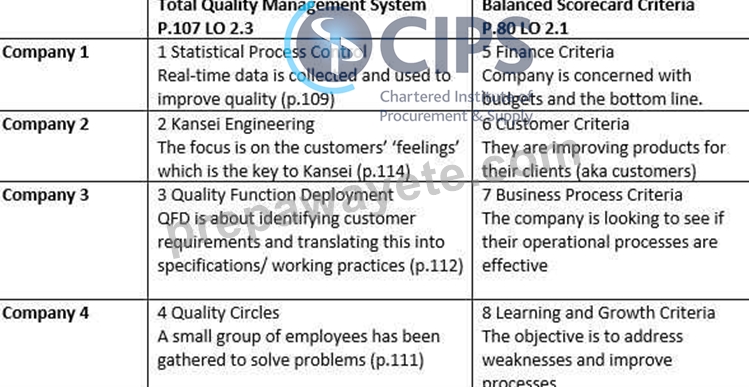
NEW QUESTION # 73
Little Joy Ltd is a large company with several functional departments. Below are details of four departments. For each, you must decide which functional area of the business the department is, as well as the SERVQUAL Gap that each Department Lead is concerned with.
Department 1: This department is concerned with the creation of products. The products are created in line with BS EN 716-1 and undergo vigorous tests before they leave the factory. Many customers are unaware of the additional costs of testing to BS EN 716-1 and complain about the price of this product line.
Department 2: Other departments of the business are internal customers of this functional area and approach the Department Lead when they require something to be bought. Often the internal customers have unrealistic expectations of the timescales involved in the process and the Department Lead spends a lot of time explaining lead times and logistics.
Department 3: This functional area creates the budgets for the company and emails these to the Department Leads at the beginning of every quarter. Due to the complexity of the documents, other functional areas of the business often don't understand the information provided.
Department 4: This area of the business is concerned with revenue, which has recently slumped. The Department Lead is conducting market surveys to find out the reason for this.
Complete the table below by listing the Functional Area of the business, and the corresponding SERVQUAL Gap. Each response should only be used once: procurement, finance, sales, production, satisfaction gap, delivery gap, standards gap, communication gap.
Which of the following will you put into box 7?
- A. communication gap
- B. delivery gap
- C. standards gap
- D. satisfaction gap
Answer: A
Explanation:
The correct answers are as follows: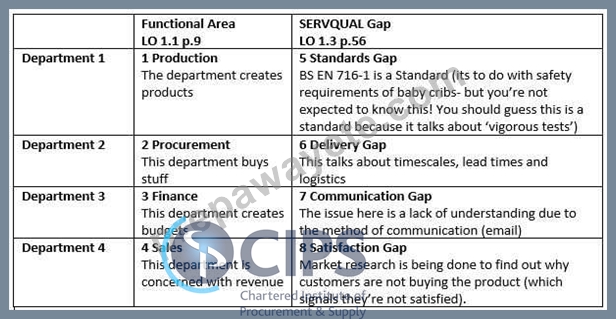
NEW QUESTION # 74
Below are details of 4 local manufacturing companies. For each company you must decide what the main objective is for the organisation and what layout their manufacturing plant has.
Company 1: This company creates large, delicate products which are hard to move. The main aim of the company is to stand out from competitors due to the superior level of materials used and by using the latest forms of technology to create the items.
Company 2: This company produces 72 different items and has designated zones within its premises for the creation of each item. The zones are organised based on the technology used and some products may be passed between different zones to be completed. The company creates many different items in response to changing customer demands, with many product lines only lasting a single season.
Company 3: Company 3 creates one product which flows along a single production line, with staff members adding to the product on four different occasions. The company must produce a high volume of this singular product in order to break even. Therefore, there is always a steady flow of items through the plant and it is important there is no stoppage in production.
Company 4: This company produces small batches of products, as and when they are ordered by customers. Due to uncertainty in demand, a high profit margin is added to the cost of each item. Teams in the factory are grouped into different areas depending on the technological process they are using.
Complete the table below by listing the objective criteria and plant layout for each company. Each response should only be used once: flexibility, speed, quality, cost, functional layout, cell layout, product layout, fixed-position layout
Which of the following will you put into box 4?
- A. speed
- B. flexibility
- C. quality
- D. cost
Answer: D
Explanation:
The correct answers are as follows:
NEW QUESTION # 75
Below are details of five companies who operate a Total Quality Management System (TQM). For each company, select the system used and identify which area of the Balanced Scorecard this relates to.
Company 1: The focus of this company is to gather real-time data to assess the quality of products created during the manufacturing process. There are tight budgets and reworking any defects will affect the bottom line.
Company 2: This company is concerned about how their products are received. They have recently completed market research focused on their client's feelings. The objective is now to improve the product's look and performance to meet these expectations.
Company 3: The focus of this company is defining the customer requirements and translating this into a high-quality specification and effective operational process.
Company 4: Within this company there is a group of 6 employees who meet regularly with the objective of reducing issues that arise in the manufacturing of products.
Complete the table below by listing the TQM System used and the relevant Balanced Scorecard criteria for each company. Each response should only be used once: Quality Circle, Statistical Process Control, Kansei Engineering, Quality Function Deployment, Finance Criteria, Business Process Criteria, Learning and Growth Criteria, Customer Criteria.
Which of the following will you put into box 3?
- A. quality circle
- B. quality function deployment
- C. kansei engineering
- D. statistical process control
Answer: B
Explanation:
The correct answers are as follows:
NEW QUESTION # 76
A lorry used for transporting goods between warehouses has a light that flashes up on the dashboard when engine oil needs to be replaced soon. This is an example of what form of maintenance?
- A. reactive
- B. run to breakdown
- C. preventative
- D. condition-based maintenance
Answer: D
Explanation:
This is an example of condition-based maintenance. This is when, prior to failure, the user is alerted to a potential problem and given time to fix it before it happens. Preventative maintenance is proactively checking regularly, so in this scenario it would be the driver checking the oil level manually before each journey. Reactive maintenance would be changing the oil when it needs changing (not beforehand). Run to breakdown would be driving the vehicle until it doesn't go any more then replacing the vehicle. See p.103.
NEW QUESTION # 77
Shireen is an Operations Manager at a cake factory. She has been asked by her manager to create a list of the transforming resources used within the factory. Which of the following would appear on her list? Select TWO
- A. employees who work on the production line
- B. raw materials such as flour and sugar
- C. facilities such as mixing equipment and ovens
- D. Information such as recipes
Answer: A,C
Explanation:
Employees and Facilities are 'transforming resources'. Raw Materials and Information are 'transformed resources'. TransformING means they do the work of converting something into something else. TransformED means they change into something. See p.45 of the study guide for more information on this.
NEW QUESTION # 78
Moto Ltd is a car manufacturer based in Japan. They implement a Kansei Engineering process. In Kansei Engineering which of the following is considered?
- A. ethical considerations
- B. customer emotions
- C. costs of raw materials
- D. environmental impact
Answer: B
Explanation:
Customer emotions are considered in Kansai- its about creating products which meet customers' 'aesthetic and performance expectations'. P.114
NEW QUESTION # 79
Total Quality Management is built on 8 founding principles. Which of the following do these include? Select THREE.
- A. supply chain integration
- B. process improvement
- C. bottom-up process design
- D. employee involvement
- E. fact-based decision making
Answer: B,D,E
Explanation:
The other 5 principles are; customer focus, system integration, communication and continuous improvement
NEW QUESTION # 80
There are four manufacturing companies located on Seashell Industrial Estate. Each company creates a different product and employs a different maintenance approach to its operations. For each company, select the corresponding maintenance approach and the key operating process characteristic.
Company 1: This company creates craft beer and offers customers a tour of the brewery for a small charge. The brewing equipment is serviced monthly and the brewery is kept extremely clean. All equipment is labelled with the last service date.
Company 2: This company produces seasonal items such as Easter Eggs and Christmas Cake. The equipment has a control panel where lights will flash red advising staff to check oil levels and components. Staff can then report issues to the maintenance team if remedial work is required. Product demand fluctuates throughout the year.
Company 3: This equipment does not often break down and is only fixed when it is reported by staff as no longer working. Company 3 creates toys, providing a large range of product sizes and colours based on different customer requirements.
Company 4: Parts of the machine are serviced quarterly but in general, the machine is left to run its course and is then replaced when it is no longer financially viable to fix. The company produces cereal and the operating process is focused on the quantity produced and therefore uses standardised processes.
Complete the table below by listing the maintenance approach and operating process characteristic for each company. Each response should only be used once: preventative maintenance, run to breakdown maintenance, condition-based maintenance, mixed maintenance, volume, visibility, variation, variety
Which of the following will you put into box 2?
- A. preventative maintenance
- B. mixed maintenance
- C. run-to-breakdown maintenance
- D. condition-based maintenance
Answer: D
Explanation:
The correct answers are as follows: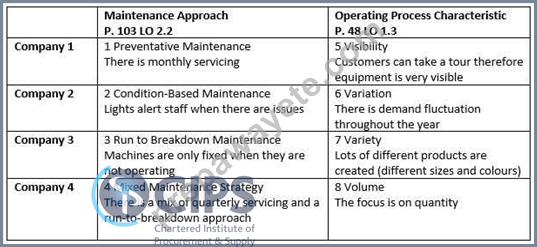
NEW QUESTION # 81
George has recently been hired as the new Operations Manager at a cake factory. He has 10 years; experience but his most recent employment was as an Operations Manager in an accountancy firm. George believes that the skills and responsibilities of an Operations Manager is the same regardless of the organisation he works for. Which of the following would be one of these responsibilities? Select TWO
- A. manage a team
- B. increase profit
- C. create competitive advantage
- D. keep customers happy
Answer: C,D
Explanation:
The correct answer is keep customers happy and create competitive advantage. This is from p.4 of the study guide. The key in this question is that you're looking for a universal responsibility for an Operations Manager- something that doesn't depend on the organisation. For this reason increase profits and managing a team are incorrect. Not every Ops Manager will be tasked to increase profits and not every Ops Manager will have direct line management responsibilities. The study guide states 'their key role is to guarantee that available resources and efficiently used in order to create competitive advantage for the organisation and keep customers satisfied'.
NEW QUESTION # 82
There are four manufacturing companies located on Seashell Industrial Estate. Each company creates a different product and employs a different maintenance approach to its operations. For each company, select the corresponding maintenance approach and the key operating process characteristic.
Company 1: This company creates craft beer and offers customers a tour of the brewery for a small charge. The brewing equipment is serviced monthly and the brewery is kept extremely clean. All equipment is labelled with the last service date.
Company 2: This company produces seasonal items such as Easter Eggs and Christmas Cake. The equipment has a control panel where lights will flash red advising staff to check oil levels and components. Staff can then report issues to the maintenance team if remedial work is required. Product demand fluctuates throughout the year.
Company 3: This equipment does not often break down and is only fixed when it is reported by staff as no longer working. Company 3 creates toys, providing a large range of product sizes and colours based on different customer requirements.
Company 4: Parts of the machine are serviced quarterly but in general, the machine is left to run its course and is then replaced when it is no longer financially viable to fix. The company produces cereal and the operating process is focused on the quantity produced and therefore uses standardised processes.
Complete the table below by listing the maintenance approach and operating process characteristic for each company. Each response should only be used once: preventative maintenance, run to breakdown maintenance, condition-based maintenance, mixed maintenance, volume, visibility, variation, variety
Which of the following will you put into box 1?
- A. preventative maintenance
- B. mixed maintenance
- C. run-to-breakdown maintenance
- D. condition-based maintenance
Answer: A
Explanation:
The correct answers are as follows:
NEW QUESTION # 83
Which of the following are considered 'transformed resources' and an input into the Operations Process (input- processoutput)?
Select THREE
- A. information
- B. raw materials
- C. customers
- D. money
- E. employees
Answer: A,B,C
Explanation:
Customers, Raw Materials and Information are inputs. This is from p.44-45. Raw materials is the obvious one- it's the input in manufacturing and is transformed into a finished good. Information is an input in the service industry- for example a lawyer or an accountant requires information in order to prepare their case. Customers is the other correct answer and is an input in things like hairdressing (you can't cut hair without a customer's head!). Employees are considered transforming inputs not transformed resources (p.45). Money is also not an input as it isn't converted into an output.
NEW QUESTION # 84
Operations Management is concerned with the management of resources in the production of tangible goods. Is this TRUE?
- A. no - operations management can also be concerned with the creation of intangible goods
- B. no- operations management is concerned with ensuring the organisation is profitable
- C. yes- operations management ensures there are sufficient goods produced to meet customer demand
- D. yes- operations management is ensuring a company has the correct resources to create goods
Answer: A
Explanation:
you can't touch or hold), also requires operations management. P.2
NEW QUESTION # 85
Below are details of five companies who operate a Total Quality Management System (TQM). For each company, select the system used and identify which area of the Balanced Scorecard this relates to.
Company 1: The focus of this company is to gather real-time data to assess the quality of products created during the manufacturing process. There are tight budgets and reworking any defects will affect the bottom line.
Company 2: This company is concerned about how their products are received. They have recently completed market research focused on their client's feelings. The objective is now to improve the product's look and performance to meet these expectations.
Company 3: The focus of this company is defining the customer requirements and translating this into a high-quality specification and effective operational process.
Company 4: Within this company there is a group of 6 employees who meet regularly with the objective of reducing issues that arise in the manufacturing of products.
Complete the table below by listing the TQM System used and the relevant Balanced Scorecard criteria for each company. Each response should only be used once: Quality Circle, Statistical Process Control, Kansei Engineering, Quality Function Deployment, Finance Criteria, Business Process Criteria, Learning and Growth Criteria, Customer Criteria.
Which of the following will you put into box 8?
- A. business process criteria
- B. finance criteria
- C. learning and growth criteria
- D. customer criteria
Answer: C
Explanation:
NEW QUESTION # 86
The DMAIC Methodology includes five phases, what are these?
- A. define, measure, analyse, improve, control
- B. design, measure, apply, improve, consult
- C. define, manufacture, apply, increase, conclude
- D. design, manufacture, analyse, implement, control
Answer: A
Explanation:
1 is the correct answer. DMAIC stands for define, measure, analyse, improve, control. It's a common methodology applied in Six-Sigma. P.137
NEW QUESTION # 87
Building redundancy into operational procedures increases what for an organisation? Select TWO
- A. risk
- B. costs
- C. customer satisfaction
- D. reliability
Answer: B,D
Explanation:
the correct answers are costs and reliability. 'Building in redundancy' means having a backup for if something goes wrong. An example is in a hospital where there is a main electricity server, but if this breaks, there is a backup generator which can power the building. In IT, you may have a back-up hard-drive for if you lose your data. Having a backup will incur additional costs, but it also improves reliability. P.101
NEW QUESTION # 88
There are 5 foundational aspects of Total Productive Maintenance. Which of the following do these include? Select THREE
- A. shining
- B. sustaining
- C. selecting
- D. selling
- E. sorting
Answer: A,B,E
Explanation:
The 5S Model is always to do with cleaning and organising. Therefore the correct answers are sorting, sustaining and shining. You may have seen this in other modules and the words might be slightly different, for example sweeping sometimes comes up instead of shining. The reason for the changes is that these are translations from Japanese, and depending on who translated it, the list is sometimes different. They always make the words begin with S though. See p.110
NEW QUESTION # 89
Below are details of 4 local manufacturing companies. For each company you must decide what the main objective is for the organisation and what layout their manufacturing plant has.
Company 1: This company creates large, delicate products which are hard to move. The main aim of the company is to stand out from competitors due to the superior level of materials used and by using the latest forms of technology to create the items.
Company 2: This company produces 72 different items and has designated zones within its premises for the creation of each item. The zones are organised based on the technology used and some products may be passed between different zones to be completed. The company creates many different items in response to changing customer demands, with many product lines only lasting a single season.
Company 3: Company 3 creates one product which flows along a single production line, with staff members adding to the product on four different occasions. The company must produce a high volume of this singular product in order to break even. Therefore, there is always a steady flow of items through the plant and it is important there is no stoppage in production.
Company 4: This company produces small batches of products, as and when they are ordered by customers. Due to uncertainty in demand, a high profit margin is added to the cost of each item. Teams in the factory are grouped into different areas depending on the technological process they are using.
Complete the table below by listing the objective criteria and plant layout for each company. Each response should only be used once: flexibility, speed, quality, cost, functional layout, cell layout, product layout, fixed-position layout
Which of the following will you put into box 5?
- A. fixed-position layout
- B. cell layout
- C. product layout
- D. functional layout
Answer: A
Explanation:
The correct answers are as follows:
NEW QUESTION # 90
Bilal is an Operations Manager at an apple pie manufacturer and is currently undertaking an Aggregate Capacity Analysis.
What is the purpose of this?
- A. It will help Bilal decide if he needs to hire more workers in the short term to ensure the factory produces enough apple pies to meet demand
- B. It will help Bilal assess if he is working within the allocated budget
- C. It will give Bilal an overall evaluation of the company's ability to meet demand fluctuations
- D. It will tell Bilal if he has the correct number of apples he needs to produce the desired number of apple pies
Answer: C
Explanation:
4 is the correct answer. Aggregate Capacity Analysis looks as medium-term capacity to see whether supply can match demand. This is from p.23. Aggregate means 'from a group or cluster' and therefore requires quite a few bits of data. For this reason option 1 is incorrect as this describes a very short term look at capacity analysis.
NEW QUESTION # 91
Below are details of five companies who operate a Total Quality Management System (TQM). For each company, select the system used and identify which area of the Balanced Scorecard this relates to.
Company 1: The focus of this company is to gather real-time data to assess the quality of products created during the manufacturing process. There are tight budgets and reworking any defects will affect the bottom line.
Company 2: This company is concerned about how their products are received. They have recently completed market research focused on their client's feelings. The objective is now to improve the product's look and performance to meet these expectations.
Company 3: The focus of this company is defining the customer requirements and translating this into a high-quality specification and effective operational process.
Company 4: Within this company there is a group of 6 employees who meet regularly with the objective of reducing issues that arise in the manufacturing of products.
Complete the table below by listing the TQM System used and the relevant Balanced Scorecard criteria for each company. Each response should only be used once: Quality Circle, Statistical Process Control, Kansei Engineering, Quality Function Deployment, Finance Criteria, Business Process Criteria, Learning and Growth Criteria, Customer Criteria.
Which of the following will you put into box 6?
- A. business process criteria
- B. finance criteria
- C. learning and growth criteria
- D. customer criteria
Answer: D
Explanation:
The correct answers are as follows:
NEW QUESTION # 92
......
L5M9 Exam Dumps - Free Demo & 365 Day Updates: https://www.prepawayete.com/CIPS/L5M9-practice-exam-dumps.html
Free Sales Ending Soon - Use Real L5M9 PDF Questions: https://drive.google.com/open?id=1i6QBToDU7WrHaquTQLb-R91dsTVepkXp